
Best Shoes for Ozempic Feet: Fit and Cushioning Guide
Remeasure feet after GLP-1 weight loss, compare symptom-specific shoe features, test heel cups and inserts, and know when pain needs clinical care.
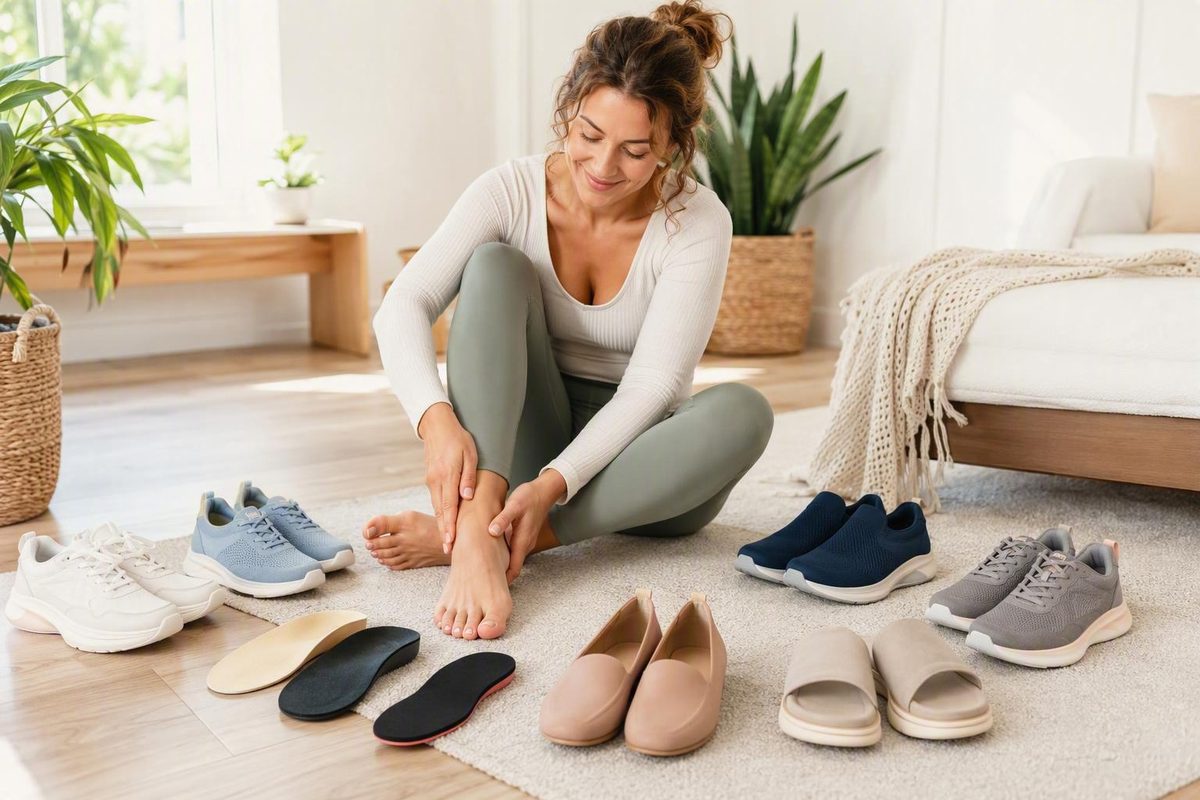
The best shoes for Ozempic feet are stable, cushioned walking shoes fitted to your current length, width and foot volume—not your old shoe size. Remeasure both feet before buying, look for a deep heel cup, secure heel hold, firm rather than wobbly cushioning and a removable insole. Add a cushioned or gel heel insert when appropriate, and see a pedorthist or clinician if pain continues after a proper refit.
Enter your previous fit and current symptom; the tool will build a refitting plan without guessing your new shoe size.
This planner selects shoe features and the next fitting step from your symptom. It cannot convert pounds lost into a new shoe size because no validated conversion is available.
These details document the fit change. They do not produce a predicted size or determine whether a symptom is medically serious.
Your Current Refit Result
Remeasure first; try stable heel cushioning and a deep heel cup.
For heel tenderness, keep the rearfoot secure and soften impact without choosing a platform that feels wobbly.
Insert and fitting stepTry a cushioned or gel heel insert only if the shoe has enough depth. Recheck collar height and heel slip after adding it.
Your old size, weight lost and time on medication cannot establish your new length or width. Measure both feet while standing.
| Current Problem | Shoe Features | Insert Option | Escalation Point |
|---|---|---|---|
| Heel tenderness | Deep heel cup, stable cushioning, secure rearfoot, adequate internal depth | Cushioned or gel heel insert; confirm it does not raise the heel into the collar | Assessment for sudden, severe, worsening or sharply localized pain |
| Ball-of-foot “pebbles” feeling | Forefoot cushioning, adequate toe width, stable rocker trial, removable insole | Professionally positioned metatarsal pad or full-length cushioned insert | Assessment if pain changes gait, persists or is localized over a bone |
| Heel slipping | Fresh length and width measurements, lower-volume fit, adjustable closure | An insert is not a reliable fix for a shoe that is too long or too wide | Pedorthist if slipping continues after changing size, width or last shape |
| General sensitivity | Smooth interior, nonbinding upper, toe room, stable sole, minimal seams | Full-length cushioned insole if it remains flat and preserves toe depth | Assessment for burning, sensory loss or unexplained widespread pain |
| Fluctuating swelling | Adjustable closure, stable enclosed heel, representative-time fitting | Use only with usual socks or prescribed compression garments | New, one-sided, warm, red, persistent or painful swelling needs assessment |
| Numbness, wound or gait change | Temporary protective, pressure-free fit while arranging care | Do not experiment with pressure-redistributing pads on an insensate or injured foot | Prioritize medical or podiatric assessment, particularly with diabetes |
Source note: Decision criteria are drawn from the article’s cited Healthline and U.S. News medical reporting and its feature-based fitting guidance. No pounds-to-shoe-size formula or clinically proven Ozempic shoe is available.
No brand or model has been clinically proven best for “Ozempic feet” or for everyone taking a GLP-1 medication. The right choice depends on whether your problem is heel tenderness, pain under the ball of the foot, general sensitivity or a shoe that has become too loose.
More cushioning is not automatically better. A very soft sole can still be unsuitable if your foot slides inside the upper or the platform feels unstable while standing, turning or walking.
Ozempic Feet Describes Changes After Weight Loss
“Ozempic feet” is an informal expression for reported changes in foot appearance, padding, comfort or shoe fit after substantial or rapid weight loss. It is not a formal diagnosis or an established direct adverse effect caused specifically by Ozempic or another GLP-1 medication. Similar changes can follow weight loss from other causes, and they do not affect everyone taking these medications (Healthline’s overview of reported changes).
Reported experiences include heel tenderness, pain beneath the ball of the foot, aching or burning, and a sensation described as walking on bone, rocks or pebbles. People have also reported more visible veins, bones or tendons, loose skin, heel slipping, blisters and shoes that no longer fit securely.
Substantial weight loss may change the width and volume of a foot and reduce some natural cushioning beneath the heel or forefoot. A shoe that once fit may then become loose enough to permit rubbing. Some people report moving to a narrower width, but that does not mean every foot narrows or that measured length necessarily changes.
Appearance and loading pain are different issues. More visible tendons or veins may be cosmetic. Tenderness beneath the heel or metatarsal heads affects standing and walking and deserves a fit review.
Do not assume every new symptom comes from weight loss. Burning, numbness, tingling, swelling, sharply localized bone pain or difficulty walking can have other causes. Footwear cannot distinguish reduced padding from neuropathy, a stress injury, edema, arthritis or plantar heel pain. U.S. News guidance likewise advises evaluating foot discomfort rather than treating the informal label as a diagnosis.
That distinction is especially important with diabetes. Loose shoes can rub, tight shoes can create pressure, and reduced sensation may make either problem difficult to detect.
Match the Shoe to the Pain Location
| Symptom | Prioritize | Avoid Or Verify | Next Step |
|---|---|---|---|
| Heel tenderness | Stable heel cushioning, deep cup, secure heel | Repeated lift, hard cup edges, wobbly foam | Try a heel cup if the shoe has enough depth |
| Ball-of-foot pain | Forefoot cushioning, stable rocker trial, removable insole | Thin flexible sole, narrow forefoot, poorly placed pad | Ask a fitter about metatarsal-pad placement |
| General sensitivity | Smooth interior, nonbinding upper, toe room | Rough seams, stiff overlays, stacked inserts | Inspect skin after each trial |
| Heel slipping | Fresh measurements, closer heel and midfoot fit | Extra length, excess depth, painfully tight laces | Change size, width or last shape |
| Fluctuating swelling | Adjustable closure, stable enclosed heel | Fitting only when swelling is lowest | Have new or one-sided swelling assessed |
| Numbness or a wound | Protective pressure-free fit | Treating sensory loss through shopping alone | Arrange clinical assessment |
Heel Tenderness Needs Cushioning Without Drift
Look for cushioning beneath the heel, a broad contact area and an upper that holds the rearfoot comfortably. A deep heel cup helps contain the heel. A removable insole leaves room to try a cushioned or gel heel insert, but the device must not raise the heel into the collar or create pressure around its edge.
Judge cushioning while walking rather than by squeezing the midsole. A shoe can feel plush in your hands yet harsh underfoot, or soft underfoot but unstable during turns.
Ball-of-Foot Pain May Benefit From a Rocker Trial
A stable rocker-style sole changes how the shoe rolls through push-off and may make forefoot loading more comfortable for some people. It has not been clinically established as a treatment for GLP-1-associated symptoms and will not suit every gait.
Reject a rocker shoe if it pitches you forward, feels unstable, creates lateral pressure or is difficult to control on stairs. A metatarsal pad is another possibility, but placement is sensitive. A podiatrist, pedorthist or qualified fitter should position it rather than repeatedly experimenting on an already painful foot.
Heel Slipping Usually Means the Fit Has Changed
Repeatedly tightening laces may pull the upper painfully across the instep without correcting excess length, depth or heel volume. The heel can continue slipping even while the top of the foot feels compressed.
A different size, width, last shape or lower-volume model may work better. Do not automatically choose a wider shoe merely because it is marketed as comfortable or therapeutic.
General Sensitivity Requires a Smooth Interior
Run your hand inside the shoe and feel for seams, folds, stiff overlays and rough transitions. The toes need space to rest naturally, but the entire shoe should not be loose. A rounded forefoot can coexist with a secure heel and midfoot.
Four Fit Features Matter More Than Brand
Stable Cushioning Must Remain Controllable
Appropriate cushioning reduces harsh ground contact while keeping the foot centered. There is no universal ideal thickness. Test whether heel strike feels less harsh, the forefoot remains comfortable during push-off and the platform stays predictable when you turn.
If you grip with your toes, shorten your stride or tense your feet to maintain balance, the cushioning is not working well for you. A broad sole does not compensate for an oversized upper.
Length, Width and Depth Need Separate Checks
Length determines clearance ahead of the longest toe. Width determines whether the forefoot is compressed or sliding sideways. Depth determines vertical room over the toes and instep, including space for an insert.
Roughly a thumb’s width ahead of the longest toe while standing is a common reference, not an absolute rule. Too much length can permit sliding after a loss of foot volume; too little crowds the toes.
A roomy toe box describes shape and space around the toes, while width is a sizing dimension. You may need a rounded forefoot with a regular-width heel, more vertical toe depth without greater width, or a narrower overall shoe than before weight loss.
Secure Heel Retention Should Not Require Painful Lacing
The heel should not repeatedly lift, rub the collar or require extreme lace tension. Check it on level ground and, when safe, on a ramp or stairs. Sliding forward on a descent can indicate too much length, depth or midfoot width.
Alternative lacing can fine-tune an otherwise appropriate fit. It cannot repair a fundamentally incorrect size or shape.
Removable Insoles Preserve Adjustment Space
A removable factory insole can create room for a heel cup, metatarsal pad, full-length cushioned insert, supportive prefabricated insole or prescribed orthotic.
Do not assume a new device can sit on top of the original insole. Stacking inserts reduces depth, crowds the toes and may push the heel into a wider part of the collar. Recheck the complete fit whenever an internal component changes.
Medication use alone is not a reason to choose a stability shoe. Neutral, stability and rocker designs should be selected for the foot’s structure, gait, symptoms and intended activity—not the medication name.
Six Feature-Based Shoes Are Worth Trying
These models were recommended by a footwear retailer’s fitting team. They have not been independently compared head to head, clinically validated for GLP-1-related symptoms or established as treatments. The retailer sells footwear and fitting services, so treat the list as a fitting-room shortlist rather than a ranking (Rosendahl Foot & Shoe Center’s recommendations).
| Candidate | Reason to Try | Main Tradeoff | Fit Check |
|---|---|---|---|
| Brooks Ghost Max 2 | Cushioned, broad platform | May feel bulky or reduce ground feedback | Confirm heel and midfoot security |
| Xelero Steadfast Walker, men’s | Rocker geometry for a forefoot trial | Rocker may alter stride | Test turns and stairs |
| Xelero Steadfast, women’s | Same rocker rationale | Transition may not suit every foot | Match rocker position to foot length |
| New Balance 928, men’s | Multiple-width comparison | Width range does not guarantee shape match | Secure heel without toe compression |
| New Balance 928, women’s | Size-and-width comparison | A wide size may worsen slipping | Compare width, depth and toe shape |
| Orthofeet Nira, women’s | Nonbinding upper and removable-insole concept | Accommodating upper may feel loose | Check forward and side movement |
The descriptions reflect the retailer’s account rather than independent specification checks. Construction, available widths and insole designs can change, so verify the current version before buying.
There is no overall winner. Ghost Max 2 represents cushioning on a broad platform; the Xelero models provide rocker options; New Balance 928 provides width choices; and Orthofeet Nira represents an accommodating upper. Reject any model that slips, rubs, compresses a tender area, pushes the toes together or forces an unnatural stride.
Remeasure Both Feet Before Replacing Shoes
Measure both feet while standing and record length and width separately. Measurements are a starting point; internal shoe shapes vary among models and brands.
Fit the foot requiring more accommodation. One foot may be longer, wider, deeper or more sensitive. Do not solve a width problem by adding length, because excess length can increase sliding and toe gripping.
Wear the socks, hosiery or prescribed compression garments you normally use. Bring any orthotic or insert and fit the complete system rather than the empty shoe.
Stand fully upright and check clearance ahead of the longest toe. Make sure the toes are not forced inward, the upper does not press on a prominent joint or toenail, and the forefoot remains centered over the platform.
Walk at your normal pace, stop, turn and use stairs if safe. For a longer trial, remain indoors while the return policy still applies. Afterward, inspect both feet for rubbing, blisters, persistent redness, concentrated indentation, warmth, numbness or tenderness.
Old shoes need reassessment when the heel repeatedly slips, the upper looks loose, the laces require much more tightening, the foot moves sideways or new blisters and calluses appear. Orthotics made before substantial weight loss also deserve reassessment. No fixed reassessment timetable is supported here; respond when fit, skin condition, comfort or function changes.
Add Inserts Only After Correcting Shoe Fit
A heel cup may help localized heel tenderness by cushioning and containing the heel. It works best with a removable factory insole, sufficient rearfoot depth, secure closure and a collar that remains below sensitive areas. Remove it if the heel sits too high, starts slipping or develops edge pressure.
A metatarsal pad may help ball-of-foot discomfort, but small placement changes can alter pressure. Stop using it if pain increases, numbness develops or skin becomes irritated. People with diabetes, neuropathy, reduced sensation or an active skin injury should seek professional guidance before experimenting with pressure-redistributing pads.
A full-length cushioned insole may suit broad underfoot sensitivity. It should lie flat, remain stationary and preserve room for the toes and instep. When the shoe is designed for replacement insoles, remove the factory insole instead of stacking devices.
Custom orthotics may be considered when pain persists despite an appropriate shoe and simpler insert, walking is impaired, anatomy is complex or a clinician identifies a specific mechanical or medical need. Available evidence does not establish that custom orthotics consistently outperform well-selected prefabricated inserts for reported Ozempic feet.
Warning Signs Take Priority Over Shoe Shopping
Minimalist shoes, unsupported flats and barefoot walking on hard surfaces may feel harsh when heel or forefoot padding feels reduced. Narrow toe boxes concentrate pressure, while backless shoes can encourage gripping and provide poor heel retention. Very soft platforms may feel unstable despite their thickness. Persistent pressure is a fit warning, not a break-in stage to endure.
Seek medical or podiatric assessment for an open sore, a blister that is not healing, spreading redness, warmth, swelling, severe or worsening pain, sharply localized bone pain, numbness, tingling, unusual coldness, a rapid change in foot shape, a new limp or difficulty standing or walking. These signs warrant particular caution when diabetes is present.
If you have diabetes, inspect the soles, heels, sides and spaces between the toes, and check inside shoes before putting them on. Do not rely on pain alone to reveal a pressure problem.
Do not stop, reduce or otherwise change Ozempic or another GLP-1 medication because of foot symptoms without speaking to the prescribing clinician. Foot pain may need assessment, but changing a prescription is not a footwear decision.
This guidance provides general footwear information rather than individualized medical or podiatric care, as explained in the site’s Terms of Use.