
School Shoes That Don’t Fit: Problems And Fit Checks
Use seven fit checks to catch tight, loose or oversized school shoes, assess hand-me-downs, and know when pain or gait changes need clinical care.
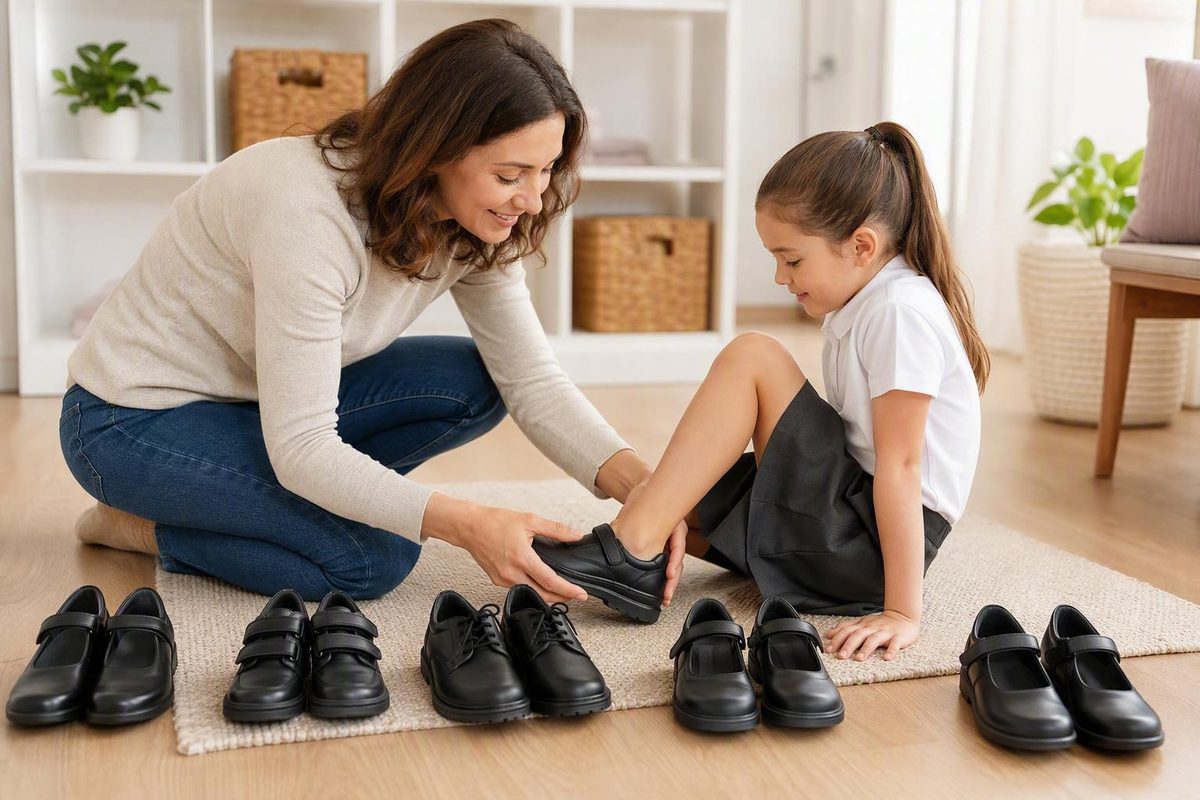
School shoes that do not fit are a foot-health issue, not merely a budget annoyance. Children’s footwear prices rose 4.7% year over year in June 2026—the fastest pace in nearly four years—while a commissioned survey found that 61% of parents had bought school shoes too big. Tight budgets do not make secondhand or inexpensive shoes inherently unsafe, but buying room to grow, skipping width checks and relying on size alone can expose children to pressure, rubbing and unstable movement (WWD).
Poor fit can contribute to redness, blisters, calluses, nail pressure, ingrown toenails and general foot pain. Shoes that are too long, wide, deep or loose can also let the heel lift and the foot slide, causing friction and making walking less secure. The practical safeguard is not a higher price: it is checking length, width, depth, heel hold and movement before accepting the shoes.
The Budget-Pressure Explanation Is Partly Right
The received view treats higher school-shoe prices as another household expense. That is fair. Children outgrow shoes, replacement cannot always wait, and families may reasonably compare cheaper pairs, buy secondhand or try to extend a shoe’s useful life.
The June figures support that concern. Children’s footwear inflation was higher than men’s footwear at 3.4% and women’s at 4.3%. The Footwear Distributors and Retailers of America projected that full-year 2026 footwear prices would rise at the third-fastest rate in 34 years; more than half of surveyed footwear executives expected landed costs to increase by as much as 10% (WWD).
Price, however, is not a fit measurement. The available evidence does not show that inflation caused parents to choose poorly fitting shoes. It does show that fit shortcuts were already widespread as prices accelerated.
A Start-Rite-commissioned OnePoll survey of 2,000 UK parents of children aged 4–15 reported that 61% had bought school shoes too big, 48% did not check fit properly and 38% did not consider foot width. Forty percent said their child had complained that school shoes hurt. Another 32% bought at least three pairs in a year, while reported secondhand or hand-me-down use ranged from 35% to 47% depending on school stage (ResponseSource).
These are sponsor-commissioned, self-reported findings, not clinical examinations or universal prevalence estimates. They cannot prove that a particular shoe caused a particular condition. They do identify the exact practices a fit check should catch.
Enter how you buy and assess school shoes; the checker shows whether fit shortcuts or protective checks win for your choices.
This screen counts documented fit shortcuts. It does not diagnose an injury or predict whether a child will develop one.
- Check the widest part of each foot against the widest part of the shoe.
- Check depth over the toes, nails and instep.
- Fasten the shoe and test heel hold.
- Watch the child walk, turn and take quicker steps.
| Practice | Shortcut Points | Reason For Review |
|---|---|---|
| Thumb test only | 1 | Front space does not establish width, depth or heel hold. |
| Label or no fit check | 2 | The survey reported 48% did not check fit properly. |
| No separate width check | 1 | The survey reported 38% did not consider width. |
| Secondhand pair | 1 | Shape, wear and fit must be reassessed for the new wearer. |
| No depth check | Review | A shoe can have enough length but press on nails or the instep. |
| No heel check | Review | Excess length or volume can permit lift and sliding. |
| No walking check | Review | Movement can reveal gripping, scuffing, slipping or limping. |
The equal-weight shortcut score is an editorial screening aid: 0–1 means protective checks win; 2 or more means fit shortcuts win. Missing depth, heel and walking checks generate actions but do not add points because the survey did not provide percentages for them.
| Reported Measure | Figure | What It Does Not Prove |
|---|---|---|
| Parents buying shoes too big | 61% | Not a clinically measured national prevalence. |
| Parents not checking fit properly | 48% | Does not identify each omitted check. |
| Parents not considering width | 38% | Does not diagnose a width-related injury. |
| Parents buying 3+ pairs yearly | 32% | Three pairs is not itself a fit failure. |
| Secondhand use by school stage | 35–47% | Secondhand status alone does not establish poor fit. |
| Children’s footwear inflation, June 2026 | +4.7% | Does not show that price caused fit shortcuts. |
Sources: Start-Rite-commissioned OnePoll survey of 2,000 UK parents, distributed by ResponseSource; June 2026 footwear CPI figures reported by WWD. Survey responses were self-reported, not clinical examinations.
Poor Fit Creates Pressure Or Excess Movement
A shoe can carry the child’s usual size and still have the wrong shape. Medical-association guidance recommends assessing children’s footwear for length, width and depth rather than relying on size alone (FootCareMD).
Short, narrow and shallow shoes create different pressure patterns. A short shoe contacts the ends of the toes. A narrow shoe compresses the forefoot from the sides. A shallow shoe presses down on the toes, nails or instep.
Oversized shoes create movement instead of direct compression. If the fastening cannot hold the foot, the heel may rise and the foot may slide forward. The child may grip with the toes, rub at the heel, scuff the ground or develop blisters despite having ample space in front.
| Observation | Possible Fit Issue | Check Next |
|---|---|---|
| Toes contact the end | Too short | Longest toe while standing |
| Toes curl or nails rub | Too short or shallow | Front and upper clearance |
| Red side marks | Too narrow | Forefoot against sole shape |
| Marks over the instep | Too shallow | Depth and fastening position |
| Heel lifts repeatedly | Too long, wide or deep | Heel hold after fastening |
| Foot slides forward | Loose or oversized | Length, volume and fastening |
| Toe gripping or scuffing | Child may be stabilizing the shoe | Walking and turning |
| Blisters at the heel | Movement or local pressure | Heel lift and shoe edge |
These observations are clues, not diagnoses. Bruised nails, heel irritation, calluses and repeated redness justify inspecting the shoes, but footwear may not be the only cause.
The survey release quotes footcare clinician Karen Randell as saying that roughly 70% of adult foot issues originate in childhood and describing ingrown toenails, corns, calluses, chronic heel pain, clawed toes, hammertoes and overlapping toes seen in practice in connection with childhood shoe fit. That statement strengthens the case for prevention, but it does not establish that ill-fitting school shoes inevitably cause adult deformity. Bunions, hammertoes and persistent gait changes have multiple influences.
Growing Room Must Remain Secure Now
Reasonable space in front of the toes allows movement and growth. Spare space everywhere does not.
Approximately 10–15 mm, or roughly a thumb’s width, beyond the longest toe is a practical guide rather than an exact rule. It must be checked with the child standing and followed by width, depth, heel and walking checks (Posture Podiatry).
The thumb test alone misses several failure points. It cannot tell whether the forefoot is compressed, the upper presses on a toenail, the instep lacks depth or the heel slips. It can also be misleading if the examiner presses the child’s toes backward or mistakes the big toe for the longest toe.
Width and volume are related but different. Width is the side-to-side space needed by the forefoot. Volume or depth is the space above the toes and instep. Buying extra length does not correct either mismatch. It may leave unused space in front while adding heel lift, sliding or tripping.
| Too Tight Or Shallow | Too Long, Wide Or Loose |
|---|---|
| Toe and nail compression | Forward sliding |
| Side pressure and calluses | Heel lift and blisters |
| Restricted toe movement | Toe gripping for stability |
| Instep pressure | Side gaping |
| Forefoot crowding | Scuffing or stumbling |
Painful shoes should not be treated as shoes that merely need breaking in. If a hard edge rubs, the toes are compressed or the child’s walking changes during the trial, choose another size or shape.
Seven Checks Establish Whether School Shoes Fit
Use The Socks And Inserts Worn At School
Fit the shoes with normal school socks and any prescribed orthoses or other inserts. An insert occupies space, potentially changing the required depth, fastening position and heel hold.
Check Both Feet While Standing
Assess each foot while the child is upright and bearing weight. One foot may be longer, broader or higher-volume. Fit to the larger foot, then confirm that the smaller foot remains secure.
A substantial difference between the feet or repeated difficulty finding a workable pair warrants help from a trained fitter, podiatrist or other qualified clinician.
Find The Longest Toe
The big toe is not always the longest. Position the heel correctly, locate the longest toe and assess the front space without pushing the toes backward.
If the insole is removable, the child can stand on it with the heel correctly positioned. FootCareMD suggests approximately half an inch ahead of the toes as a practical check. An insole can reveal an obvious length or width mismatch, but it cannot assess upper depth or heel security.
Match The Forefoot Width
The widest part of the foot should align with the widest part of the shoe. Look for side pressure, forefoot bulging, stretched upper material or a foot spilling over the sole edge.
Do not automatically add length when the sides are tight. Compare a wider fitting or a model built on a different shape.
Check Depth Above The Toes And Instep
The upper should not press on the toes, nails or top of the foot. A strap that barely reaches, widely separated laces or marks across the instep may indicate insufficient depth.
Side gaps, excess upper material or a fastening that must be pulled unusually tight can indicate too much volume. The child should be able to move the toes without the foot sliding forward.
Secure The Heel And Midfoot
Fasten the shoes as they will be worn at school. Laces, straps or buckles should hold the heel and midfoot without squeezing the forefoot.
Repeated heel lift, obvious side gaping or forward sliding indicates a poor match. A heel that becomes secure only when the toes are compressed is also the wrong shape.
Watch Walking, Turning And Quicker Steps
Watch from the front, side and behind while the child walks, turns both ways and, where safe, takes quicker steps. Look for sliding, toe gripping, heel lift, scuffing, stumbling, limping or a clear departure from the child’s usual movement.
Ask where the shoe touches rather than only whether it fits. Younger children may communicate discomfort by removing the shoes, avoiding running, sitting more or asking to be carried.
Podiatry guidance similarly recommends considering length, width, shape, comfort, symmetry and stability while the child stands and walks, rather than trusting the labeled size alone (My FootDr).
Secondhand Shoes Need A New-Wearer Assessment
A hand-me-down is not automatically unsafe, and a new shoe is not automatically suitable. Ignore the size label long enough to conduct a complete assessment for the current wearer.
Check length, width, depth, heel hold, fastening, outsole wear and retained shape. Reject a pair that is significantly distorted, unevenly worn, damaged or unable to secure the foot. A shoe molded to one child’s foot may not suit another child with the same nominal size.
Buying substantial extra length to postpone replacement can create slipping and rubbing immediately. A safer budget strategy is a secure current fit with reasonable growing room, followed by regular checks. Fit and condition matter more than whether the shoe is premium-priced, inexpensive or previously worn.
Replacement Depends On Growth And Wear, Not A Fixed Date
The available guidance does not establish one universal replacement interval for every school-age child. Age, activity and growth rate differ. The survey’s finding that 32% of parents buy at least three pairs a year describes purchasing behavior, not a clinical replacement prescription.
Recheck fit after a growth spurt and whenever there is new pain, redness, nail pressure, heel slip, blistering, changed activity or altered walking. Replace or refit shoes when the toes approach the front, width or depth becomes restrictive, the fastening no longer secures the foot or excessive movement cannot be corrected.
Inspect the shoe itself for a substantially worn or uneven outsole, distorted heel, damaged fastening, separated components or an upper that no longer retains its shape. Practical podiatry guidance also identifies sole or heel wear, loss of structure, outgrown shoes and new discomfort as replacement signs (Bluebonnet Foot and Ankle Institute).
Insoles Cannot Correct A Mismatched Shoe
Most healthy children do not automatically need special arch supports or orthotics simply because they are buying school shoes. A flat-looking arch can be normal in younger children; appearance alone does not establish pain, impaired function or a need for treatment.
An insole cannot make a short toe box longer, widen a narrow forefoot, reduce excessive length or correct a poorly shaped heel. Because it occupies space, it can worsen toe, nail or instep pressure when the shoe lacks depth.
If a child has prescribed orthoses, take them to every fitting. Recheck length, width, depth, fastening, heel hold and walking with the device installed. Persistent symptoms or marked alignment concerns need individual assessment rather than an unprescribed insert.
Persistent Pain And Gait Changes Need Assessment
Replacing an obviously tight or loose shoe is reasonable. Repeatedly buying different sizes is not an adequate response to continuing symptoms.
Arrange assessment by a pediatrician, podiatrist or other qualified clinician for persistent or worsening pain, swelling, a visible limp, recurring heel or arch pain, unusual walking, repeated falls, unequal foot growth, activity avoidance, recurring sores, significant nail injury or symptoms that continue in appropriately fitted footwear.
Scuffing, fatigue, clumsiness and unusual wear are nonspecific. They do not prove that school shoes caused the problem. Sudden severe pain, spreading redness or numbness should be handled according to the site’s medical-information and safety notice (The Shoes for Me).
A pair passes only when it is comfortable immediately, leaves reasonable room beyond the longest toe, accommodates the forefoot and instep, holds the heel and permits normal walking. That standard costs attention, but it does not require an expensive brand.