
Are Chanel Barefoot Shoes Bad for Your Feet?
Chanel's sole-less heel cap leaves the forefoot exposed. Compare risks on carpet, pavement, sand and club floors with flip-flops and minimalist shoes.
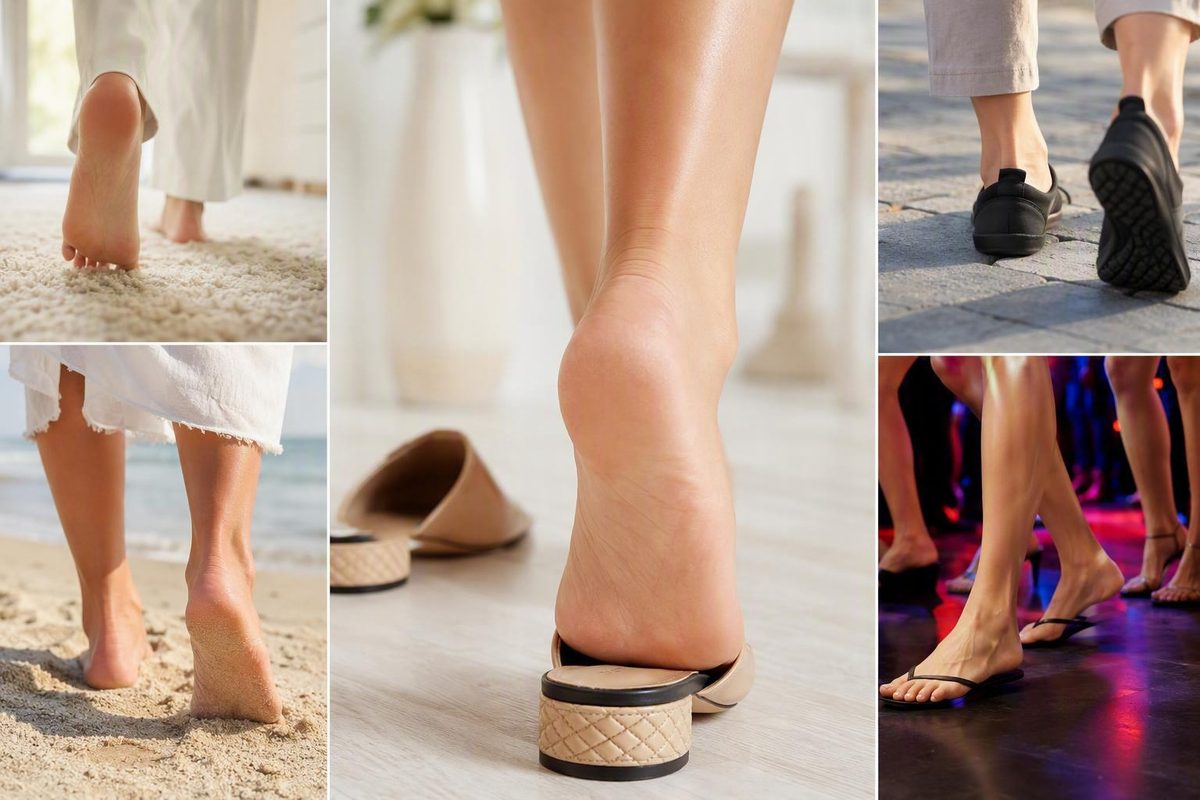
Chanel’s “barefoot” shoes are a poor choice for pavement because the photographed design is essentially barefoot walking with a heel cap and ankle fastening. It offers little or no visible protection from sharp debris, rough ground, heat or repeated pressure beneath the forefoot, while the rear structure adds a potential rubbing point. Brief wear on clean carpet may be reasonable if the actual pair fits, but this is not an everyday walking shoe.
Choose a surface to compare what each option puts between your foot and the ground.
Select the surface you expect to cross. “Acceptable” means the option supplies a workable barrier for that setting, not that it treats pain or guarantees safety.
Pavement result: choose a continuous outsole.The Chanel-style heel cap and true barefoot leave the forefoot unprotected from rough texture, debris and ground temperature.
Clean Carpet
- Conditional: Chanel-style heel cap
- Acceptable: flip-flop
- Acceptable: ballet flat
- Acceptable: minimalist shoe
- Acceptable: barefoot
Pavement
- Avoid: Chanel-style heel cap
- Conditional: flip-flop
- Acceptable: ballet flat
- Acceptable: minimalist shoe
- Avoid: barefoot
Beach
- Conditional: Chanel-style heel cap
- Acceptable: flip-flop
- Conditional: ballet flat
- Acceptable: minimalist shoe
- Conditional: barefoot
Club Floor
- Avoid: Chanel-style heel cap
- Conditional: flip-flop
- Acceptable: ballet flat
- Acceptable: minimalist shoe
- Avoid: barefoot
| Selected Surface | |||||||
|---|---|---|---|---|---|---|---|
| Chanel-Style Heel Cap | None at exposed forefoot | None at exposed forefoot | None from an outsole | Unrestricted | Added cap and strap contact | Clean skin; cap care unknown | Avoid |
| Flip-Flop | Basic continuous sole | Limited barrier | Model-dependent | Usually open | Usually no heel contact | Often easy; material varies | Conditional |
| Ballet Flat | Continuous sole | Basic barrier | Usually limited | Often restricted | Enclosed heel may rub | Material-dependent | Acceptable |
| Minimalist Shoe | Thin continuous sole | Limited barrier | Thin, flexible layer | Usually wide | Enclosed; fit-dependent | Material-dependent | Acceptable |
| True Barefoot | None | None | None from footwear | Unrestricted | No footwear friction | Skin can be washed | Avoid |
Ratings describe the physical barrier and likely contact points, not clinical outcomes. Actual materials, fit, debris and surface temperature can change the result.
Source basis: reported Chanel construction in Grazia, People and ELLE, plus the article’s design-based comparison. No Chanel-specific clinical or mechanical test figures are available.
That verdict is based on the reported construction, not Chanel-specific injury data. No supplied evidence provides clinical studies, pressure measurements, infection rates, stability tests or long-term outcomes for the sandals. The design creates obvious exposure, but it has not been proved to injure every wearer.
The Chanel Design Leaves the Weight-Bearing Forefoot Bare
Fashion reports describe a small or structured heel cap secured around the ankle while the toes, ball of the foot and much of the sole remain uncovered. Grazia reports that the front sole is cut out and the forefoot sits directly on the pavement.
That reverses the construction of an ordinary sandal. A conventional sandal can expose the top and sides of the foot while retaining an outsole beneath the heel, forefoot and toes. Chanel’s photographed design appears to retain the shoe at the rear without placing a continuous layer beneath the front of the foot.
Margaret Qualley wore a black pair from Chanel’s Cruise 2027 collection at the Dog Stars London premiere on 20 August 2026. Photographs showed her forefoot against the hard arrival surface, according to People’s coverage of the appearance. That establishes event wear, not how far she walked, how long she kept them on or whether she experienced pain.
The style was quickly treated as a broader fashion trend. Jeffrey Campbell copies priced at £46–£55 had reportedly sold out by 24 August, while ELLE grouped Chanel’s “barefoot heels” with autumn 2026 naked jazz shoes. None of that coverage presents the design as tested walking, protective or therapeutic footwear.
Photographs cannot confirm every construction detail. A transparent film, partial outsole or later retail change could be difficult to see. Anyone considering a pair should turn the actual shoe over and establish exactly which parts of the toes, forefoot, arch and heel have material beneath them.
These Are Not Minimalist Barefoot Shoes
A minimalist or “barefoot” shoe normally has a thin, flexible but continuous outsole. It may also have a wide toe box and a zero-drop platform, meaning the heel is not raised above the forefoot. Those are common commercial category descriptions rather than a universal medical standard.
The continuous sole is the critical difference. It preserves ground feel while still placing material between the skin and the surface. An enclosed minimalist upper also provides more coverage than a heel cap.
The Chanel design reportedly leaves the forefoot in direct contact with the ground. In functional terms, it is closer to going barefoot with a rear attachment than to wearing a minimalist shoe.
| Option | Underfoot Barrier | Toe Space | Rear Contact |
|---|---|---|---|
| Chanel-style heel cap | Forefoot reportedly bare | Unrestricted | Heel cap and strap |
| Minimalist shoe | Thin, continuous sole | Usually wide | Enclosed upper |
| Flip-flop | Continuous open sole | Usually open | Usually none |
| Ballet flat | Continuous sole | Often tapered | Enclosed heel |
| Barefoot | None | Unrestricted | None |
This distinction limits the value of minimalist-shoe transition advice. Gradually adapting to a thin sole may change how the feet and lower legs tolerate loading. It cannot stop glass, grit, hot paving or a dirty floor from touching exposed skin.
Skin Takes the Most Immediate Risk
With no conventional outsole beneath the forefoot, coarse paving and small debris can contact the skin directly. Abrasions, cuts and punctures are plausible consequences. No supplied source reports how often these injuries occur among Chanel wearers, so there is no defensible injury rate to quote.
Surface temperature is another direct-contact problem. An exposed forefoot has no visible insulation from hot paving or very cold concrete. The supplied evidence does not measure the design’s thermal protection or identify a temperature at which it becomes unsafe.
The heel cap creates a separate skin issue. It may keep the shoe attached, but its edge and ankle fastening can press or rub as the foot moves. That friction point does not exist when truly barefoot. Its severity will depend on the material, fit, adjustment and duration, none of which has been independently tested in the evidence available here.
Before wearing the pair beyond a clean room, check for pressure at the back and sides of the heel. Turn, take several careful steps and notice whether the cap shifts or the fastening constricts. Pain, numbness, broken skin or an insecure fit are reasons to stop the test.
Plantar Fascia Effects Have Not Been Measured
A sole-less forefoot provides no visible cushioning or pressure-spreading layer. On hard ground, the skin and underlying tissues therefore meet the surface without the mediation supplied by an ordinary outsole. Longer walking creates more repetitions of that contact.
That does not prove the shoes cause plantar fasciitis, Achilles injury, stress fractures, altered gait or falls. No Chanel-specific gait, impact, pressure or cushioning measurements are available. Claims that the design causes those conditions would go beyond the evidence.
People who already have plantar-fascia symptoms, Achilles problems, persistent foot pain or a previous bone-stress injury have less reason to experiment. The lack of data means suitability cannot be inferred from photographs or from another person’s short event appearance.
Commercial minimalist-shoe guidance often recommends increasing wear gradually. One seller suggests starting with a few minutes and simple standing or short walks, while another proposes a progression of roughly three to six months. Those differing seller recommendations concern thin-soled shoes, not direct skin contact with the ground. There is no established Chanel transition schedule.
Toes Can Splay, but They Are Unprotected
The open front does not compress the toes into a narrow shoebox. In that limited sense, it permits more toe splay than a tapered ballet flat.
Freedom is not protection. Exposed toes can meet rough texture, sharp fragments, spills and temperature extremes directly. They also lack the toe coverage of an enclosed minimalist shoe and the underfoot platform of a flip-flop.
The design may be particularly awkward where the route includes curbs, gravel, transit stations or unexpected detours. A heel strap can retain the rear of the shoe, but it cannot shield the toes or create a stable platform beneath them.
Direct Floor Contact Changes the Hygiene Problem
A public floor can transfer dirt and other material directly to an uncovered sole. Moist club floors, shared indoor areas and city pavement create more opportunities for contamination than a clean, inspected carpet.
Contamination is not the same as infection. No supplied source gives a Chanel-specific infection rate or documents a clinical series of infected wearers. Describing the shoe as certain to cause infection would be unsupported.
The practical response is to avoid wearing it over open cuts, blisters, cracks or other damaged skin. After use, inspect and wash the exposed areas of the foot. Cleaning the heel cap will depend on its material and Chanel’s care instructions, which are not provided in the available reporting.
Carpet Is Different From Pavement
A short appearance on clean carpet limits exposure compared with hours on public pavement. It does not remove heel-cap friction, spills or overlooked debris, but it is the setting most consistent with the design’s limitations.
Pavement is a poor match. Rough concrete, grit, broken surfaces, moisture and changing ground temperatures can all reach the forefoot. For commuting, sightseeing or walking several blocks, a continuous outsole is the more protective choice.
A beach is not automatically safe. Sand may hide sharp material and can become hot, while the heel cap may collect sand and rub. Bare feet or the Chanel-style heel cap both remain exposed; a flip-flop or minimalist shoe at least supplies a sole.
A club floor introduces spills, sticky residue and debris that may be difficult to see in low light. The heel attachment does not compensate for the absent forefoot barrier. Change into the style only after reaching a genuinely controlled area, and keep full-soled backup shoes available.
Some Feet Need a Larger Safety Margin
People with diabetes, reduced sensation, impaired circulation, an open wound or a recent foot injury should seek individualized clinical guidance before wearing footwear that exposes the sole. Someone who cannot promptly feel heat, rubbing or skin damage may not receive an early warning to stop.
The same caution applies to severe rigid deformity, limited joint mobility, significant existing foot pain and prescribed footwear or orthoses. This does not mean Chanel’s design is proved to cause a particular complication. It means a fashion-based experiment should not override an existing treatment or protection plan.
Remove the shoe if it causes sharp or escalating pain, numbness, visible skin injury or an insecure feeling. Persistent redness, swelling or increasing soreness also warrants assessment rather than repeated testing. Altered sensation after wearing heels should not be treated as a normal breaking-in effect.
Inspect the Actual Pair Before Wearing It
First establish whether there is a transparent or partial outsole. Check the underside in good light and feel where the material ends. Photographed runway or celebrity-worn pairs may not be identical to a retail version.
Then test the heel cap on a clean surface. It should not cut into the ankle, create immediate pressure or move noticeably when you turn. No independent information is available about sizing, strap pressure, heel height or stability on stairs and slopes.
Plan the entire route rather than the photographed part of the event. The journey may include a parking area, pavement, entrance queue, stairs, long corridor or unplanned walk. Travel in full-soled footwear and change only after reaching the controlled space.
Carry backup shoes that can handle the real distance. A conventional sandal, covered flat or minimalist shoe with a continuous outsole provides more surface separation than a genuinely sole-less forefoot. A transparent or skin-toned outsole can preserve much of the visual effect without requiring direct ground contact.
Chanel Barefoot Shoe Questions
Do Chanel Barefoot Shoes Have a Sole?
The photographed design is reported to have a heel cap and ankle fastening while leaving the toes, ball of the foot and much of the sole uncovered. Images appear to show direct forefoot contact with the ground.
It is not possible to confirm that every runway, celebrity or retail version has absolutely no transparent or partial layer. Inspect the actual pair rather than treating editorial photographs as a technical specification.
Are They Safe for Walking on Pavement?
They are poorly suited to routine pavement walking. The reported construction provides little or no visible separation from rough texture, debris, dirt, moisture and ground temperatures. No clinical threshold establishes a safe distance or duration.
Can They Cause an Infection?
Direct floor contact creates an opportunity for contamination, particularly if the skin is already broken. No supplied evidence shows that infection is common or inevitable among wearers.
Are They Bad for Everyone’s Feet?
No universal harm has been demonstrated. A short appearance on clean carpet is materially different from an extended city walk. The defensible objection is that the design removes ordinary surface protection and adds heel contact without supplying a tested health benefit.