
Ingrown Toenail vs Fungus: How to Tell the Difference
An ingrown toenail is primarily mechanical: a corner or side of the nail presses or grows into the adjacent skin. Toenail fungus, also called onychomycosis, is…
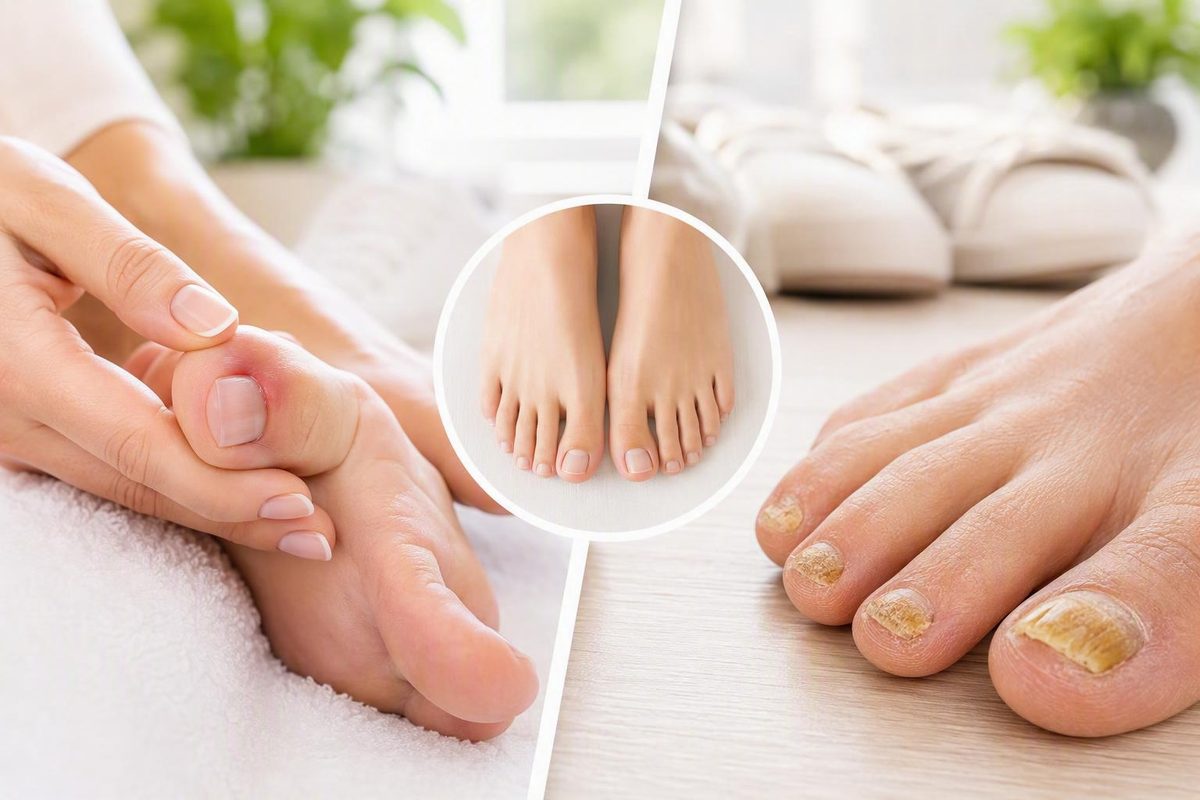
The short answer: compare the nail edge with the nail plate
An ingrown toenail is primarily mechanical: a corner or side of the nail presses or grows into the adjacent skin. Toenail fungus, also called onychomycosis, is an infection involving the nail itself. Painful, inflamed skin along one nail edge therefore favors ingrowth, while gradual changes spread across the nail plate favor possible fungus. WebMD describes these differing patterns, diagnostic approaches, and treatment paths.
Use this location-first rule of thumb:
- Likely ingrown nail: focal pain, tenderness, redness, warmth, or swelling where one corner or side meets the skin.
- Possible fungal nail: white, yellow, or brown discoloration; thickening; brittleness; crumbling; distortion; debris; or lifting involving more of the nail plate.
- Mixed or uncertain: broad nail changes together with a sharply painful, inflamed edge—or an appearance that does not fit either pattern cleanly.
Pain is generally more characteristic of an ingrown toenail. It may become especially noticeable when a shoe, sock, bedsheet, or light touch presses the affected edge. Fungus can cause discomfort, particularly when the nail becomes thick or damaged, but pain alone cannot establish the cause. Trauma, repeated pressure, advanced nail disease, ingrowth, and infection around the nail can blur the distinction.
| Feature | Ingrown toenail | Possible toenail fungus |
|---|---|---|
| Main affected area | Junction between one nail edge or corner and the surrounding skin | Nail plate, often beginning near the tip and extending more broadly |
| Typical onset | May follow trimming, tearing, pressure, or trauma; discomfort can become noticeable relatively quickly | Usually develops gradually as color and texture change |
| Pain pattern | Often focal, sharp, tender, or pressure-sensitive along one side | Often little pain initially; discomfort may occur as the nail thickens or separates |
| Nail color | Nail may remain normal in color, although inflammation, bleeding, or debris can alter the appearance | May become white, yellow, yellow-brown, or otherwise discolored |
| Thickness and texture | Nail edge may be curved, jagged, or hidden by swollen skin | Thick, brittle, crumbly, distorted, ragged, debris-filled, or lifted |
| Surrounding skin | Commonly red, swollen, tender, or warm at the affected edge | May look relatively normal early on; irritation can occur in advanced or complicated cases |
| Drainage | Pus or liquid can occur if tissue around the edge becomes infected | Drainage does not prove nail fungus and may indicate a separate complication |
| Likely contributors | Nails cut too short or rounded, torn corners, tight shoes, repetitive pressure, trauma, naturally curved nails | Fungal exposure, trapped moisture, small nail breaks, shared tools, or communal wet environments |
| Diagnostic approach | Often recognized from the embedded edge, surrounding skin, and symptoms | Appearance may raise suspicion, but nail debris or clippings may need laboratory examination |
| Treatment pathway | Reduce pressure and address the penetrating edge; severe or recurrent cases may need a procedure | Confirm the cause, then use a clinician-selected antifungal when appropriate |
| Expected visual improvement | Inflammation may settle after pressure and penetration are resolved, although recurrence is possible | Damaged nail remains visible until it grows out, so cosmetic improvement can be slow |
Treat the table as a comparison tool, not a diagnostic test. A clinician may recognize straightforward ingrowth from the location of the edge and surrounding inflammation, while suspected fungus can require closer examination because several nonfungal disorders look similar.
The comparison leads to three possible working conclusions:
- Likely ingrown toenail: the problem is concentrated along one painful nail edge.
- Possible fungal nail: the main issue is gradual discoloration, thickening, crumbling, distortion, or lifting across the nail.
- Mixed or uncertain findings: both patterns are present, the toe is draining, or several different causes remain plausible.
This article can help you organize what you see and choose a next step. It cannot confirm an individual diagnosis and is general information rather than medical care.
Signs that point more strongly to an ingrown toenail
An ingrown toenail affects the boundary where the nail meets the surrounding skin. It most commonly occurs on the big toe, although any toe can be affected. The defining feature is not simply a nail that looks unhealthy; it is an edge or corner pressing into soft tissue.
Typical signs include:
- Tenderness concentrated at one side or corner
- Sharp, aching, or throbbing pain at the edge
- Red, inflamed, or swollen skin beside the nail
- Warmth around the tender area
- Pain that increases when a shoe, sock, bedding, or light touch applies pressure
- Skin that appears to overlap or grow over the edge
- A nail edge that curves downward or becomes difficult to see
The nail itself does not have to be thick, yellow, or crumbly. In an early case, it may look relatively normal except for the way one corner meets the skin. In a more advanced case, swelling or overgrown tissue can conceal the edge, making it difficult to see whether the nail is entering the skin.
Common contributors include cutting the nail too short, rounding deeply into its corners, tearing rather than clipping a corner, wearing shoes that crowd the toes, injuring the nail, and having a naturally curved nail shape. Mayo Clinic lists crowded footwear, overly short or rounded trimming, trauma, and pronounced nail curvature among the causes of ingrown toenails. Its guidance also identifies pain, inflamed skin, swelling, and possible infection as characteristic findings.
Pressure is an important clue. A toe may feel reasonably comfortable when bare but become sharply sore in a particular shoe. That does not prove ingrowth—the shoe could also be pressing on a bruised or thickened nail—but pain concentrated at one nail border makes an embedded edge more plausible.
Not all inflammation beside a nail means infection. A nail edge pressing into skin can trigger redness, tenderness, and swelling without pus. Infection becomes a greater concern when there is liquid drainage, pus, bleeding, increasing warmth, worsening or throbbing pain, fever, or redness extending beyond the immediate nail fold. Healthdirect lists these findings as warning signs associated with an infected ingrown toenail.
Do not try to solve a severe or infected ingrown nail by cutting down the side, digging beneath the nail, or tearing out a hidden corner. If the edge is buried, pain is substantial, or infection is possible, professional assessment is safer than continued cutting or probing.
Signs that point more strongly to toenail fungus
Toenail fungus primarily changes the nail plate. Instead of beginning with a single tender corner, it often appears as a gradual alteration in color, thickness, texture, shape, or attachment to the nail bed.
A possible progression is:
- A white or yellow spot appears near or beneath the nail tip.
- Discoloration expands across more of the nail.
- The nail becomes thicker or harder to trim.
- An edge becomes brittle, ragged, or crumbly.
- The nail becomes distorted, collects debris, or lifts away from the nail bed.
The color may range from white to yellow or yellow-brown. The nail may also lose its smooth, uniform surface. These changes are more suggestive when they extend across the plate rather than remaining confined to one painful side. Pinnacle Dermatology describes spot-like discoloration followed by possible thickening, crumbling, distortion, brittleness, and separation.
Fungal changes can cause mild discomfort, especially if a thick nail presses against a shoe. Even so, marked focal pain with red, swollen skin at one edge is more characteristic of an ingrown toenail. If a discolored nail suddenly becomes intensely painful, warm, or surrounded by drainage, do not assume uncomplicated nail fungus explains everything. Pressure, trauma, ingrowth, or infection around the nail may also be present.
Fungi favor warm, moist environments. Exposure may occur around communal showers, pools, gyms, or locker rooms, while wet or sweaty footwear can keep the nail environment damp. Sharing clippers, towels, or nail tools may create an opportunity for spread, and a small break in the nail can provide a route of entry.
Nail fungus is not necessarily a sign of poor hygiene. A person can wash regularly and still encounter fungal organisms or develop an infection after minor nail damage. It can also spread between people, which is why shared tools and damp communal areas matter.
Most importantly, a thick or discolored nail is not automatically fungal. A checklist or photograph can raise suspicion but cannot establish the cause. Do not choose a prolonged over-the-counter, prescription, or home-remedy antifungal solely from appearance.
Can you have fungus and an ingrown toenail at the same time?
Yes. An ingrown toenail and toenail fungus are distinct conditions, but they are not mutually exclusive.
One affects the nail’s relationship with the surrounding skin; the other is an infection involving the nail. A single toe can therefore show both processes. For example, a nail may be thick, yellow, distorted, and crumbly across its surface while one side is sharply painful, red, and swollen.
There is also a possible connection between them. Fungal thickening, distortion, breakage, or irregular regrowth may make it easier for an edge to press into adjacent skin. This does not mean fungus inevitably causes ingrowth. Some people may be predisposed to both, and the conditions can occur together by coincidence. A podiatry discussion of coexisting disease presents fungal nail changes as a possible mechanical contributor rather than an inevitable cause.
A practical mixed example would be:
The entire nail has gradually become thick, yellow, and crumbly, but one corner is now intensely tender and the nearby skin is red and swollen.
The broad plate changes make fungus possible. The focal edge inflammation makes ingrowth possible. An assessment may need to address both rather than forcing the findings into one diagnosis.
It also helps to separate three processes:
- Mechanical penetration: the nail edge presses or grows into the skin.
- Fungal nail infection: fungi infect the nail.
- Secondary infection around the nail: damaged tissue beside an ingrown edge becomes infected, potentially producing increased warmth, pain, pus, or drainage.
Pus beside an ingrown edge does not prove that the nail plate is fungal. It is more immediately concerning as a sign of infection in the surrounding tissue. Likewise, an antibiotic selected for a bacterial complication would not eradicate nail fungus or release an embedded nail edge.
The reverse claim should also be treated cautiously. An ingrown nail is not established as a routine cause of toenail fungus. Coexistence is easier to support than a universal cause-and-effect sequence in either direction.
Why visual inspection may not settle the diagnosis
An ingrown toenail is often recognized through a combination of location, mechanics, and symptoms. A clinician looks for a nail corner entering or pressing against the skin, examines the surrounding tissue, and asks where and when it hurts. Tests are usually unnecessary for a straightforward, uncomplicated ingrown edge.
Suspected fungus is harder to confirm visually. Thickening, discoloration, ridging, crumbling, or lifting can result from fungus, but similar changes can follow trauma, chronic footwear pressure, psoriasis, or another nail disorder. Even a nail that appears “classically fungal” may have a different cause.
When confirmation is needed, a clinician may:
- Collect nail debris or clippings
- Examine material under a microscope
- Send a sample for laboratory analysis
- Request a fungal culture in selected cases
These tests are not necessary for every nail change. Their practical purpose is to avoid treating the wrong condition. Care for fungal infection differs from care for repeated trauma, another nail disorder, or a mechanically embedded edge. Diagnostic methods described for uncertain fungal disease include examination of nail clippings, microscopy, laboratory analysis, and fungal culture.
A simple decision path is:
- Is pain and inflammation concentrated at one edge? Ingrowth becomes more likely.
- Are changes gradual and distributed across the nail plate? Fungus is possible, but not confirmed.
- Are both patterns present? Consider coexisting fungus and ingrowth.
- Is there drainage, spreading redness, substantial swelling, recurrence, or uncertainty? Arrange an assessment.
- Has cautious self-care or presumed antifungal treatment failed? Reconsider the diagnosis rather than continuing indefinitely.
Primary care can assess the toe and refer when necessary. Podiatry commonly addresses embedded nail mechanics, while uncertain nail disease may be evaluated through other appropriate clinical routes. No single specialty is automatically required for every case.
Different problems require different treatment paths
Treatment should follow the process causing the problem. Pressure relief cannot eradicate a fungal infection, while antifungal medicine cannot remove a nail edge that is penetrating skin.
Mild, uninfected ingrowth
For an otherwise low-risk person with a recent, mild ingrown edge—and no pus, spreading redness, substantial swelling, severe pain, or difficulty walking—initial care can focus on reducing irritation:
- Soak the toe in comfortably warm water.
- Clean it gently rather than scrubbing or digging.
- Dry the toe carefully afterward.
- Switch to sandals, open footwear, or shoes with enough toe-box room to avoid pressure.
- Stop cutting down the sides or repeatedly checking beneath the nail with a tool.
- Protect the toe from further impact.
Guidance differs on placing cotton or dental floss beneath a mild nail edge, and the suitability of that technique depends on the condition of the skin and nail. A cautious approach is not to force anything beneath an edge that is buried, markedly swollen, bleeding, or draining.
If symptoms worsen or fail to improve with cautious care, arrange professional assessment rather than continuing to trim, lift, or manipulate the nail. Cleveland Clinic advises against cutting a severe or infected ingrown nail and describes clinician treatment for worsening, draining, severe, or recurrent cases. Its guidance also recommends earlier care for people with diabetes, severe nerve damage, or poor circulation.
Severe or infected ingrowth
Do not attempt to cut out or remove a severe or infected edge at home. Depending on the findings, a clinician may lift the nail, remove the penetrating portion, treat drainage when indicated, or perform a procedure involving part of the nail in a severe or recurrent case.
The appropriate treatment depends on how deeply the nail is embedded, whether surrounding tissue has grown over it, whether infection is present, and whether the problem has recurred. Medication may sometimes be selected for an associated bacterial infection. That medication does not remove the mechanical cause, so the nail edge may still require treatment.
Seek care rather than continuing home treatment when pain is severe or increasing, pus or liquid is present, redness spreads, the toe becomes markedly warm or swollen, bleeding continues, walking becomes difficult, or fever develops.
Suspected fungus
Do not begin by assuming every yellow or thick nail needs an antifungal. First consider whether there has been repeated shoe pressure, running trauma, a previous bruise, detachment from the nail bed, or another skin or nail disorder.
Assessment is especially useful when:
- Several possible causes fit
- One damaged nail follows a clear injury
- The nail is painful or draining
- The change is progressing
- Previous antifungal treatment did not help
- Oral treatment is being considered
- The person has a condition that increases the consequences of a nail or foot infection
The objective is not testing for its own sake. It is matching treatment to the cause and avoiding prolonged, unsuitable care.
Confirmed fungus
Confirmed fungal nail disease may be treated with a clinician-selected topical or oral antifungal. The suitable route depends on the extent of nail involvement, the person’s health, and the need for individualized review. There is no single medicine or treatment plan that is right for everyone. WebMD describes topical and oral antifungal options and notes that examination or laboratory testing may be used to confirm nail fungus.
Antibiotics do not treat nail fungus. They may be used for selected bacterial complications, but they neither eradicate fungi in the nail nor correct an ingrown edge.
Cosmetic improvement can lag behind infection control. Antifungal treatment does not instantly replace a discolored, thickened, or distorted nail. The damaged portion must move forward as the nail grows, so the old nail may remain visibly abnormal even when treatment is working. Visible fungal damage must grow out rather than disappearing immediately.
Avoid judging success only by how the old portion looks immediately after treatment. Follow-up may be appropriate when the nail continues to worsen, symptoms persist, or the original diagnosis remains uncertain.
Footwear, trimming, and moisture control: prevent each problem by its mechanism
Prevention is more useful when it targets the underlying mechanism. Ingrowth is primarily about nail-edge mechanics and pressure. Fungal exposure is more closely related to contact, moisture, and opportunities for organisms to enter the nail.
To reduce ingrown-toenail risk
Trim nails straight across at a moderate length. Do not taper deeply into the sides, carve out the corners, or cut the nail extremely short. The purpose is to let the edge grow forward rather than leaving a short or jagged corner that can press into skin.
Choose shoes with sufficient toe-box room.
- Does the affected toe touch the upper?
- Is the big toe pushed against the second toe?
- Does the nail contact the front of the shoe on descents?
- Does one edge become sore during the day?
- Is there enough height above a thickened nail?
The goal is stable fit without repeated pressure against the nail edge.
Reconsider footwear that consistently causes pain at the same nail border. During sports or work involving repeated impact, protect the toes and make sure the foot is not sliding into the front of the shoe. Footwear changes can reduce mechanical pressure, but they do not remove a deeply embedded edge or cure an existing infection.
Straight-across trimming, moderate nail length, properly fitting shoes, and protection from toe injury are among Mayo Clinic’s recommended preventive measures. The guidance specifically advises avoiding footwear that crowds the toenails.
To reduce fungal exposure
Moisture and shared-contact precautions serve a different purpose:
- Dry feet carefully, including around the toes.
- Change socks after they become sweaty.
- Let wet footwear dry before wearing it again.
- Wear protective footwear in communal showers, pool areas, and changing rooms.
- Do not share nail clippers, files, towels, or other nail-care tools.
- Clean personal tools and avoid instruments that may not have been properly sanitized.
- Avoid repeatedly traumatizing or picking at the nail.
These habits may reduce exposure or limit conditions favorable to fungi. They do not guarantee prevention, and moisture control does not eradicate an established nail infection.
Keep the goals separate
A roomier shoe can reduce pressure on an ingrown edge, but it does not kill fungus. Dry socks and shower sandals may reduce fungal exposure, but they do not release a nail corner already embedded in skin.
When both conditions may be present, prevention may require both approaches: reduce pressure around the nail edge while also controlling moisture and avoiding shared tools.
When to stop self-care and seek medical attention
Red flags: arrange professional assessment
- Severe or increasing pain
- Pus or liquid drainage
- Marked warmth
- Redness that is spreading
- Fever
- Substantial swelling
- Bleeding or an open wound
- Difficulty standing or walking normally
- Symptoms that persist despite cautious conservative care
- Repeated recurrence
These findings may indicate an infected or more advanced ingrown nail, another nail disorder, or a complication requiring treatment. They are not reliable proof of toenail fungus. Cleveland Clinic advises evaluation for pus, drainage, extreme pain, worsening symptoms, or marked redness and warns against cutting a severe or infected nail at home. Its guidance notes that rare chronic infections can extend into deeper tissue.
Seek prompt assessment for a nail-edge wound, suspected infection, or significant inflammation if you have:
- Diabetes
- Poor circulation
- Neuropathy or reduced sensation
- A weakened immune system
- Another condition that interferes with healing
Reduced sensation can make tissue damage harder to notice, while impaired circulation can make infection and healing more consequential. Healthdirect advises medical assessment for infection signs and for people with diabetes, poor circulation, or nerve damage affecting the legs or feet. High-risk readers should not pick at or attempt to remove the nail themselves.
Serious complications are possible, particularly when an infection is not treated, but they are not the expected outcome of every sore toe. The appropriate response is to act on warning signs rather than assume either that the problem is harmless or that severe complications are inevitable.
This article can help distinguish an edge-focused pattern from a nail-plate pattern, but it cannot confirm the cause of an individual nail change. When the appearance is unclear, more than one process may be present, or the toe is worsening, examination is the safer next step.
Frequently asked questions
Is pain the easiest way to tell an ingrown toenail from fungus?
Pain is useful, but location is more informative. Sharp tenderness concentrated where one nail edge meets red or swollen skin favors an ingrown toenail. Fungus more often causes gradual nail-plate changes and may produce little discomfort early on. A clinical comparison describes pain as characteristic of ingrowth but less common with nail fungus.
Pain cannot settle every case. A thick fungal nail may hurt under shoe pressure, and an ingrown edge may coexist with fungal disease. Look at the distribution of the changes rather than relying on pain alone.
Can a thick or yellow toenail have a cause other than fungus?
Yes. Trauma, repeated footwear pressure, psoriasis, altered nail growth, and other nail disorders can resemble fungus. Thickening or yellow discoloration is therefore a reason to consider fungal disease, not proof of it.
If the cause is uncertain—particularly before prolonged treatment—a clinician may examine nail debris or clippings or send a sample for laboratory analysis. Broad discoloration and thickening support suspicion of fungus, but other nail diseases remain possible. Clinical descriptions of fungal nails emphasize that appearance must be interpreted alongside examination and diagnostic testing.
Does pus mean I have toenail fungus?
No. Pus beside a tender nail edge more immediately suggests infection in the surrounding tissue, often as a complication of an ingrown toenail. It does not establish that fungi are infecting the nail plate.
Pus, drainage, worsening warmth, spreading redness, throbbing pain, or fever should prompt medical assessment rather than an attempt to choose an antifungal at home.
Can toenail fungus make an ingrown toenail more likely?
Possibly. Fungal disease can thicken, distort, weaken, or crumble a nail. Those changes may make an edge grow irregularly or press into surrounding skin.
The relationship is not inevitable or conclusively one-way. A person may be prone to both conditions, or they may occur together by coincidence.
Why can a fungal nail still look damaged after treatment?
Treatment does not instantly replace the part of the nail that has already become thick, discolored, crumbly, or distorted. That damaged portion must grow forward and be replaced by new nail, so appearance can improve slowly.
A nail that still looks abnormal is not, by itself, proof that treatment failed. Follow-up may be needed to distinguish expected nail growth from persistent infection or a different nail disorder.
The practical summary is location-based: soreness and inflammation at one nail edge favor ingrowth, while gradual changes across the nail favor possible fungus. A thick, discolored nail with a sharply painful edge may involve both. Mild, uncomplicated ingrowth may justify cautious pressure relief, but uncertain fungus should be assessed before prolonged treatment. Drainage, spreading redness, severe pain, fever, difficulty walking, or a nail wound in someone with diabetes, poor circulation, neuropathy, reduced immunity, or impaired healing calls for prompt professional assessment.