
Foot Sleeves for Plantar Fasciitis Vary by Use
A correctly fitted sleeve may provide temporary comfort while worn. No universal maximum daily wear time is established, so follow product-specific directions.
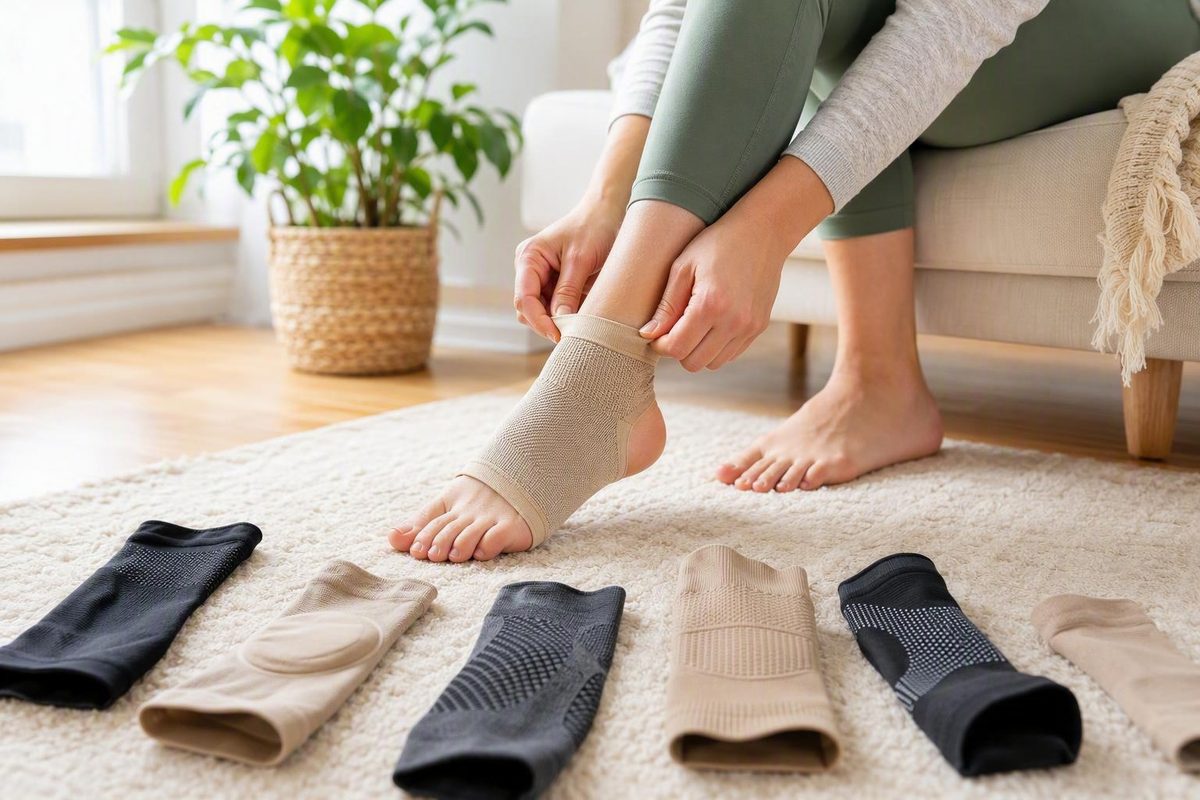
A foot sleeve for plantar fasciitis is easy to buy but difficult to compare. Search results place thin compression sleeves beside padded arch bands, ankle wraps, tall socks, orthotic inserts, and nighttime devices. Prices may cover one sleeve, a pair, or a multipair pack, while relief claims often sound more conclusive than the supporting material allows.
The practical expectation should be modest: a correctly fitted sleeve may provide temporary comfort or support while it is being worn. The sources reviewed for this article do not establish that these products heal the plantar fascia. Choose by documented construction, fit, intended wear, shoe compatibility, care requirements, package quantity, warnings, and return terms—not promises of a cure.
What a plantar-fasciitis foot sleeve is—and what it can realistically do
A foot sleeve is a relatively low-profile support covering some combination of the arch, heel, and ankle. Unlike a conventional sock, many designs leave the toes exposed. Depending on the product, support may come from:
- General elastic compression around the foot
- Targeted compression zones around the arch and heel
- Knitted bands intended to simulate taping
- A foam cushion positioned beneath the arch
- A combination of compression and cushioning
Manufacturers commonly market these products for arch or heel support, swelling management, and temporary relief during work, exercise, everyday activity, or recovery. These are intended-use and marketing claims, not proof that a sleeve repairs damaged tissue.
The sources reviewed here do not establish that foot sleeves heal, cure, reverse, or prevent plantar fasciitis. A sports-podiatry clinic article says its author found no published, peer-reviewed clinical evidence showing that plantar-fasciitis socks heal the condition. That conclusion needs careful qualification: the article is clinic commentary, not a systematic review with a documented search method. It also allows that some people may experience symptomatic relief even though healing has not been demonstrated in the clinic’s discussion of plantar-fasciitis socks.
Even an honest report of improvement cannot establish why the improvement occurred. Someone trying a sleeve may also reduce running mileage, change shoes, rest more, stretch, use cold rolling, or begin physical therapy. Symptoms may vary from day to day. Without a controlled comparison, the sleeve’s contribution cannot be separated confidently from those other changes.
A more defensible comparison therefore focuses on questions that can be answered from product documentation:
- What kind of support does the product use?
- Which parts of the foot does it cover?
- Is it intended for activity, everyday wear, rest, or sleep?
- How is the size selected?
- Does the price cover one sleeve, a pair, or several pairs?
- Will it fit inside the intended shoes?
- What are the materials and washing instructions?
- What warnings and return conditions apply?
A sleeve may still be worth trying when the goal is limited and measurable—for example, whether it makes a work shift, walk, or exercise session more tolerable while worn. That is different from expecting it to change the underlying condition.
Sleeve, sock, wrap, arch support, or night device: identify what you are buying
Product names are inconsistent, so begin with physical format rather than the words “plantar fasciitis” in the title.
A foot or foot-and-ankle sleeve generally surrounds the arch and may extend around the heel and ankle. It is usually thinner and shorter than a full sock.
A targeted-compression sleeve uses knitted zones or bands that apply different pressure around particular areas. A foam-cushioned arch support instead places a pad beneath the arch and holds it in place with an elastic band. Dr. Scholl’s product is an example of the second approach: its defining component is a foam arch cushion combined with a compression band and non-slip base, rather than compression fabric alone.
An adjustable ankle wrap usually relies on straps tightened by the wearer.
A rest-oriented or nighttime sleeve is another distinct category. It should not automatically be treated as an athletic sleeve. The Orthosleeve DS6, for example, uses compression and a knitted structure described as simulating taping, but its manufacturer restricts it to nighttime, rest, or low-activity use.
These formats are not interchangeable:
- Coverage: An arch band, ankle sleeve, and calf-high sock apply pressure to different areas.
- Support method: Cushioning, elastic pressure, straps, and inserts feel and function differently.
- Permitted activity: Some products are marketed for training; others are limited to rest.
- Placement: A padded band must align with the arch, while an anatomical sleeve may have a shaped heel pocket.
- Package quantity: Promotional photographs may show two feet even when the listing includes one sleeve.
Retail keyword pages add to the confusion. A search for “foot sleeve plantar fasciitis” returned sleeves and wraps alongside patches, orthotics, inserts, socks, cushions, and unrelated foot-care products. Search inclusion does not make every result an equivalent sleeve as illustrated by Target’s mixed results.
Use this four-part screening rule before comparing prices or ratings:
- Format: Knitted sleeve, padded arch band, wrap, sock, insert, or nighttime device?
- Coverage: Arch only, heel and ankle, or calf as well?
- Wear setting: Shoes, activity, barefoot use, rest, or sleep?
- Contents: One sleeve, one pair, or multiple pairs?
If any of these details is missing, the product is not yet ready for a meaningful comparison.
Specification comparison: six sleeve options and one budget multipair listing
The table compares seller-documented specifications rather than presumed medical effectiveness. Prices, inventory, shipping charges, ratings, FSA/HSA labels, variants, and return terms can change; verify the exact selection at checkout.
| Product | Listed price | Package quantity | Support format | Stated compression | Sizes or sizing method | Intended wear | Materials or comfort features | Care | Important limitations |
|---|---|---|---|---|---|---|---|---|---|
| OS1st FS6 | Starts at $24.99 | Single sleeve or pair | Slim sleeve with targeted arch and heel compression | No pressure figure established in the supplied material | XS–XXL; black, tan, and white, with single sleeves limited to black | Training, recovery, daily wear, and athletic or everyday footwear | 76% micro-nylon and 24% Lycra Spandex; described as seamless, breathable, and moisture-managing | Hand-wash with mild soap; air-dry; no bleach or fabric softener | Starting price does not establish every variant’s unit cost. Seller listed $7.95 shipping below $55, free shipping at or above $55 under stated conditions, and a 30-day return window for unused or lightly used products in original packaging on the OS1st FS6 page |
| OrthoSleeve plantar-fasciitis sleeve | $39.99 | Not clear in the supplied excerpt | Anatomical targeted-compression sleeve | 10–30 mmHg, according to the manufacturer | XS–2XL; black, tan, and white | Daily wear under socks or with sandals | Nylon; seamless anatomical heel; moisture-wicking and silver-based odor-control treatment | Hand-wash and air-dry | The pressure range is a seller specification, not an independently established optimum. One displayed variant was backordered on OrthoSleeve’s standard sleeve page |
| Dr. Scholl’s arch-support sleeve | $16.99 | Not established in the supplied excerpt | Foam arch cushion held by an elastic compression band; non-slip base | Not stated | Consult the current product sizing information | Shoes, socks, slippers, barefoot use, or overnight wear | Breathable, washable fabric and odor-neutralizing treatment | Described as washable; confirm complete directions | Cushion placement matters. The page’s quantified pain-relief and healing claims lack supporting study details and should not be treated as established fact on the Dr. Scholl’s product page |
| Copper Fit Ice Plantar Fascia Ankle Sleeve | $19.99 | One pair | General ankle-and-foot compression with four-way stretch | Not stated | S/M and L/XL | Everyday support and movement | 82% nylon and 18% spandex; menthol cooling sensation, moisture-wicking fabric, copper-based odor control, and seamless knit | Machine-wash cold on delicate; tumble-dry low; no bleach, ironing, or dry cleaning | Stock was unclear because sold-out indicators appeared with an add-to-cart control. Menthol and copper features do not establish treatment efficacy on Copper Fit’s listing |
| Zensah plantar-fasciitis sleeve | $25 | One sleeve | Targeted-compression sleeve | Not stated | S–XL, using shoe size and arch circumference; several listed colors | Running, recovery, and all-day wear | Seller describes moisture management, breathability, odor protection, and knitted compression technologies | Not established in the supplied excerpt | Current size and color availability was unclear; the women’s shoe-size entry for XL was incomplete on Zensah’s product page |
| Orthosleeve DS6 | $29.99 | One sleeve | Rest-oriented decompression sleeve with a knitted zone intended to simulate taping | 10–30 mmHg, according to the manufacturer | S–XL; use the seller’s size chart | Nighttime, rest, or low activity only | Nylon with silver-ion moisture-wicking, odor-control, and antimicrobial treatment | Hand-wash and air-dry | Not presented as suitable for normal or high-impact activity; stated pressure is not an independently established optimum on the Orthosleeve DS6 page |
| PAPLUS six-pair listing | $18.99 | Six pairs | Open-toe compression ankle sleeve marketed with arch and ankle support | Not established | Not established in the supplied excerpt | Not established | Detailed composition absent; listing states at least 50% recycled material under the cited certification | Not established | Compression strength, complete materials, sizing, wear instructions, contraindications, and warnings were absent. Low unit cost does not compensate for missing fit and safety information in the PAPLUS marketplace listing |
Several comparisons remain deliberately unresolved. The standard OrthoSleeve and Dr. Scholl’s excerpts did not clearly establish package quantity, so a per-sleeve calculation would require an assumption. OS1st offers single and pair formats, but its displayed starting price cannot automatically be assigned to both.
The same restraint applies to compression pressure. A commercial specification such as 10–30 mmHg describes the seller’s product; it does not prove that the range is ideal for plantar fasciitis or suitable for every wearer. A product that omits a pressure figure should not automatically be assumed weaker or safer.
No overall winner follows from the table. It reveals tradeoffs: detailed sizing versus broad size bands, hand washing versus machine care, foam cushioning versus fabric compression, activity-oriented versus rest-only wear, and low multipair cost versus limited disclosed specifications.
Choose by use case, not by an unsupported best-product ranking
The most useful shortlist begins with where and how you intend to wear the product.
Inside everyday or athletic shoes: Prioritize a thin profile, smooth seam placement, moisture management, and enough room for the sleeve plus any sock worn over it. OS1st and the standard OrthoSleeve are marketed for footwear use. A “low-profile” label still does not guarantee compatibility with a close-fitting shoe.
With sandals or while barefoot: The standard OrthoSleeve is marketed for wear with sandals. Dr. Scholl’s positions its foam-cushioned arch band for barefoot and slipper use as well as shoes. Check traction and stability rather than assuming every sleeve has a non-slip surface.
For running or training: Limit the initial shortlist to sleeves expressly marketed for activity, such as OS1st or Zensah. That classification establishes an intended setting, not superior pain relief. Exclude the DS6 from normal or high-impact activity because its manufacturer limits it to nighttime, rest, or low activity.
For work or prolonged daily wear: Compare slimness, seams, heat retention, moisture management, washing convenience, and any tendency to bunch beneath a sock. Copper Fit emphasizes moisture and odor management, while several knitted products are marketed as breathable or seamless. “All-day” marketing cannot predict comfort during an individual work shift.
For rest or nighttime: Consider only products expressly designed or marketed for that setting, then follow the selected product’s instructions. The DS6 is positioned for nighttime and rest, while Dr. Scholl’s includes overnight wear among its suggested settings. Neither statement makes every compression sleeve suitable for sleeping.
For cushioning: Dr. Scholl’s foam arch cushion is the clearest departure from fabric-only compression. It may suit someone specifically seeking a pad beneath the arch, but it requires accurate placement and enough shoe volume.
For a cooling sensation or machine washing: Copper Fit’s menthol feature may change how the sleeve feels against the skin, and its machine-washing directions are more convenient than hand washing. Cooling sensation, copper infusion, moisture management, and odor control are comfort or care features—not evidence of plantar-fascia healing.
For low initial unit cost: The PAPLUS multipair listing is inexpensive per pair, but important specifications were missing from the supplied excerpt. A budget multipack is poor value if the size, pressure, materials, intended use, or warnings cannot be verified.
The point is to match documented construction to the intended setting. “For running” means the seller presents a product as activity-compatible; it does not mean that product will relieve more pain than one marketed for work, recovery, or daily wear.
Fit comes first: sizing, pressure, and shoe compatibility
Use the exact manufacturer’s size chart for the specific model. Do not assume that a medium sock, shoe, or sleeve from one brand corresponds to a medium from another. Brands may size by shoe length, arch circumference, ankle circumference, or a combination of measurements.
When both shoe size and arch circumference are supplied, check both. Zensah provides the following example:
- Small: men’s US 4–6.5, women’s US 5–8, arch circumference 5–8 inches
- Medium: men’s US 7–10, women’s US 8.5–11, arch circumference 7–10 inches
- Large: men’s US 10.5–12, women’s US 11.5–13, arch circumference 9–13 inches
- XL: men’s US 12.5 and above, arch circumference 11–14 inches; the supplied women’s shoe-size entry was incomplete
The seller also mentioned free US shipping from $50 and a 60-day money-back guarantee. Both the sizing information and purchase terms should be rechecked before ordering on the current Zensah listing.
If shoe size and circumference point to different sizes, do not guess based solely on your usual sock size. Ask the seller how to resolve the conflict and whether the return policy permits a fit trial.
The sources reviewed do not establish a universal compression target for plantar fasciitis. Commercial pages mention ranges such as 10–30 mmHg and 20–30 mmHg, but these are seller specifications or recommendations rather than an independently established optimum. More pressure should not automatically be interpreted as better support, greater effectiveness, or better value.
Use this initial fitting checklist:
- Confirm orientation. Check for left and right versions, an anatomical heel pocket, or a defined top and bottom.
- Align the support. Position targeted bands or padding according to the manufacturer’s instructions.
- Smooth the fabric. Remove folds and wrinkles, especially beneath the arch and around the ankle.
- Check the edges. They should not roll into tight cords or dig into the skin.
- Test normal footwear. Evaluate the sleeve with the socks and shoes you ordinarily use.
- Reassess shoe volume. Check for new pressure over the instep, sides, toes, or heel.
- Walk cautiously. Look for slipping, bunching, altered balance, or increasing discomfort.
- Inspect the skin. After initial use, check areas affected by padding, seams, and edges.
Dr. Scholl’s provides a useful product-specific placement example: align its sleeve with the arch and position the foam cushion between the ball of the foot and heel. That instruction should not be transferred to fabric-only sleeves with different anatomical markers.
“Fits inside shoes” is not a universal guarantee.
The reviewed sources do not establish a universal break-in schedule or maximum daily wear time. Follow the directions for the selected product rather than inventing a timetable.
Wear and safety: when to remove a sleeve or ask for medical advice
Safety first
As a conservative rule, remove a sleeve if it causes or worsens pain, numbness, discoloration, irritation, or an apparent restriction of circulation. Those signs appear in the warning for the Dr. Scholl’s sleeve; they should not be treated as something to overcome by repeatedly tightening or repositioning the product on the manufacturer’s safety guidance.
Dr. Scholl’s also specifically tells people with diabetes or compromised or sensitive skin to consult a doctor before using its sleeve. This is one manufacturer’s warning, not a complete contraindication list for every compression product.
Many commercial pages provide little or no information about contraindications, adverse effects, unexplained swelling, skin injury, circulation concerns, or maximum wear duration. Absence of a warning on a sales page is not proof that a product is appropriate for every person.
Nighttime use is especially product-specific. Some products are marketed for overnight wear, and the DS6 is designed for nighttime or rest. Commercial guidance is nevertheless inconsistent: a CEP discussion says compression should be removed for sleep unless a healthcare provider advises otherwise, while another part permits lower-pressure nighttime compression for severe pain after physician consultation. That same page recommends a daytime pressure level without supplying direct comparative evidence in its commercial guidance for runners.
The defensible conclusion is not that overnight compression is always safe or always unsafe. It is that instructions should not be transferred between products. Use only a product explicitly intended for the setting and follow its directions. If personal health conditions make compression safety uncertain, a sales page cannot provide individualized guidance.
Do not assume that all heel or arch pain is plantar fasciitis. This article cannot determine the cause of a particular person’s symptoms, and the supplied evidence does not support a differential-diagnosis guide.
This publication defines its foot articles as general information rather than medical care. Its general notice advises clinical attention for sudden severe pain, spreading redness, or numbness, especially for someone with diabetes. That notice is a publication boundary, not a diagnosis or substitute for professional triage under The Shoes for Me’s Terms of Use.
Stop treating the decision as a shopping problem when:
- Symptoms persist or continue to worsen
- Pain changes how you walk
- A sleeve creates new pain rather than support
- Numbness, discoloration, irritation, or apparent circulatory restriction occurs
- Pain becomes sudden, severe, or otherwise unlike your usual pattern
- Redness is spreading
A product page cannot assess sensation, circulation, skin integrity, gait, or the cause of swelling. When those issues matter, selecting a tighter or more expensive sleeve is not an adequate substitute for assessment.
Price, package quantity, reviews, and returns: compare value accurately
Headline price is often misleading because package quantities differ.
Zensah and the DS6 are sold as one sleeve. Copper Fit lists one pair. PAPLUS lists six pairs. OS1st offers both single-sleeve and pair formats. If support is wanted on both feet, a single-sleeve price may need to be doubled—but only after confirming that two identical single units are appropriate and available.
Calculate unit cost only when the displayed price clearly corresponds to the displayed quantity:
- Copper Fit: $19.99 per pair, or about $10 per sleeve before tax and shipping
- PAPLUS: $18.99 for six pairs, or about $3.17 per pair
- Zensah: $25 for one sleeve
- DS6: $29.99 for one sleeve
OS1st’s starting price cannot safely be converted into a unit cost without selecting the single or pair variant. The same rule applies whenever package quantity is unclear.
Shipping and return conditions can materially change the comparison. As captured on August 17, 2026, OS1st listed $7.95 standard shipping below $55, free shipping at or above that threshold under stated conditions, and a 30-day return window for unused or lightly used products in original packaging. Those terms are included in the comparison table and should be verified again at checkout.
More importantly, determine whether the return policy allows a meaningful fit trial. “Returns accepted” does not necessarily mean that a sleeve worn through several work shifts or training sessions remains returnable. Check:
- Whether the package can be opened
- Whether the sleeve can be tried with shoes
- Whether lightly used merchandise is accepted
- Whether all packaging must be retained
- Who pays return shipping
- Whether final-sale colors or sizes are excluded
- Whether marketplace terms differ from the manufacturer’s policy
Reviews can reveal possible fit problems, but they cannot establish medical effectiveness. At the time captured, Dr. Scholl’s displayed 4.4 out of 5 from 116 reviews, Copper Fit displayed 4.3 from 109, and PAPLUS displayed 4.3 from 13,332. The large difference in review counts may reflect marketplace exposure or purchasing history; it does not identify which product heals or relieves plantar fasciitis more effectively. The latter two metrics appeared on the respective Copper Fit product page and PAPLUS marketplace listing.
Some Dr. Scholl’s reviewers reported tightness, discomfort, heaviness, or soreness, and some reviewers received free products. Those reports do not prove that the sleeve is broadly uncomfortable. They show why an average rating cannot predict individual fit, just as positive testimonials cannot isolate compression from changes in footwear, activity, rest, or other care.
Before paying, confirm:
- Current price for the exact variant
- One sleeve, one pair, or multipair package
- Correct size under the current chart
- Availability of the required size and color
- Shipping charge and delivery estimate
- Materials and care instructions
- Intended setting: shoes, activity, rest, or nighttime
- Compression specification, if provided
- Available shoe volume
- Return deadline and merchandise-condition requirements
- Whether a genuine fit trial is permitted
- Product-specific warnings
- Current FSA/HSA status, if relevant
The best value is not necessarily the lowest unit cost. It is the lowest total cost for a correctly sized, adequately documented product suited to the intended setting and returnable under acceptable conditions.
Use a sleeve as one part of a broader plan—not as a substitute for diagnosis
Commercial sources place sleeves alongside other approaches. OS1st mentions physical therapy, plantar-fascia and Achilles stretching, and athletic taping in addition to daytime and nighttime products in its commercial sleeve guide. Other commercial material discusses supportive footwear, activity modification, structured arch support, and cold rolling.
These mentions do not prove that all those measures are effective or establish a ranking among them. They show why a sleeve should not be evaluated as though it were the entire plan.
Compression alone is not established in the reviewed sources as a way to heal an injured plantar fascia. A more useful personal outcome is functional: while wearing the sleeve, can you tolerate walking, standing, work, or appropriate exercise more comfortably without adverse signs?
If the answer is no, reassess the format, placement, size, and shoe combination. Do not keep buying progressively tighter or more elaborate sleeves when symptoms persist or worsen.
A concise decision path is:
- Identify the intended use: shoes, running, work, barefoot wear, rest, or nighttime.
- Choose the format: compression sleeve, padded arch band, wrap, sock, insert, or rest device.
- Measure for the exact product: use circumference as well as shoe size when available.
- Confirm quantity and terms: check package contents, shipping, care, and returns.
- Trial it according to its instructions: do not borrow wear guidance from another product.
- Judge practical function: assess comfort and activity tolerance while worn, not promises of healing.
- Apply the safety rule: remove the sleeve if the warning signs described above occur.
- Escalate unresolved symptoms: do not let continued shopping delay appropriate assessment.
Frequently asked questions
Do plantar-fasciitis foot sleeves actually work?
They may provide temporary support or comfort for some people while worn, but individual responses vary. The sources reviewed for this article do not establish that sleeves heal or cure plantar fasciitis, and they do not identify a clinically proven best model.
Evaluate “working” in practical terms: whether a correctly fitted sleeve improves tolerance for walking, standing, work, or appropriate activity. Improvement cannot necessarily be attributed to compression if footwear, activity, stretching, rest, or other parts of the routine changed at the same time.
Can I sleep in a compression foot sleeve?
Only use a sleeve overnight when the specific product is intended for that setting and its instructions permit it. The Orthosleeve DS6 is limited to nighttime, rest, or low activity, while Dr. Scholl’s includes overnight wear among the settings for its cushioned arch sleeve. Those instructions do not apply to every compression product.
Commercial guidance about sleeping in compression is inconsistent. Do not assume that a daytime athletic sleeve is suitable for sleep merely because another product permits overnight wear.
How tight should a plantar-fasciitis sleeve be?
It should remain positioned and feel supportive without pinching, rolling, bunching, slipping, or creating new discomfort. Follow the manufacturer’s size chart rather than relying on a universal pressure target or your usual sock size.
When both shoe size and arch circumference are supplied, check both. The reviewed sources do not establish a universal compression level for plantar fasciitis. Apply the safety rule above if adverse signs occur.
Is the listed price usually for one sleeve or a pair?
There is no consistent convention. Zensah and the Orthosleeve DS6 list one sleeve; Copper Fit lists a pair; PAPLUS lists six pairs; and OS1st offers single-sleeve and pair formats. Photographs showing two feet do not prove that two sleeves are included.
Confirm package quantity for the exact selected variant before comparing unit cost. If quantity is unclear, treat cost per sleeve as unavailable rather than guessing.
What is the difference between a foot sleeve and a compression sock?
A foot or foot-and-ankle sleeve usually covers the arch, heel, and possibly the ankle while leaving the toes exposed. Its lower profile may make it easier to layer inside shoes.
A compression sock includes more of the foot and may extend up the calf. That changes coverage, heat, shoe fit, and how pressure is applied. Neither format is established here as more effective for plantar fasciitis. Both should also be distinguished from padded arch bands, adjustable wraps, inserts, and nighttime devices.
A properly fitted foot sleeve may be worth trying for temporary support. Choose it by documented fit, format, and intended use—not a promise that it will cure the condition—and do not allow continued shopping to delay assessment of persistent, severe, sudden, or worsening symptoms.