
Dorsal Night Splint: Uses, Fit and Evidence
Explains first-step heel-pain guidance, dorsal vs. posterior designs, fitting and safety, plus six products compared by price, sizing and adjustment.
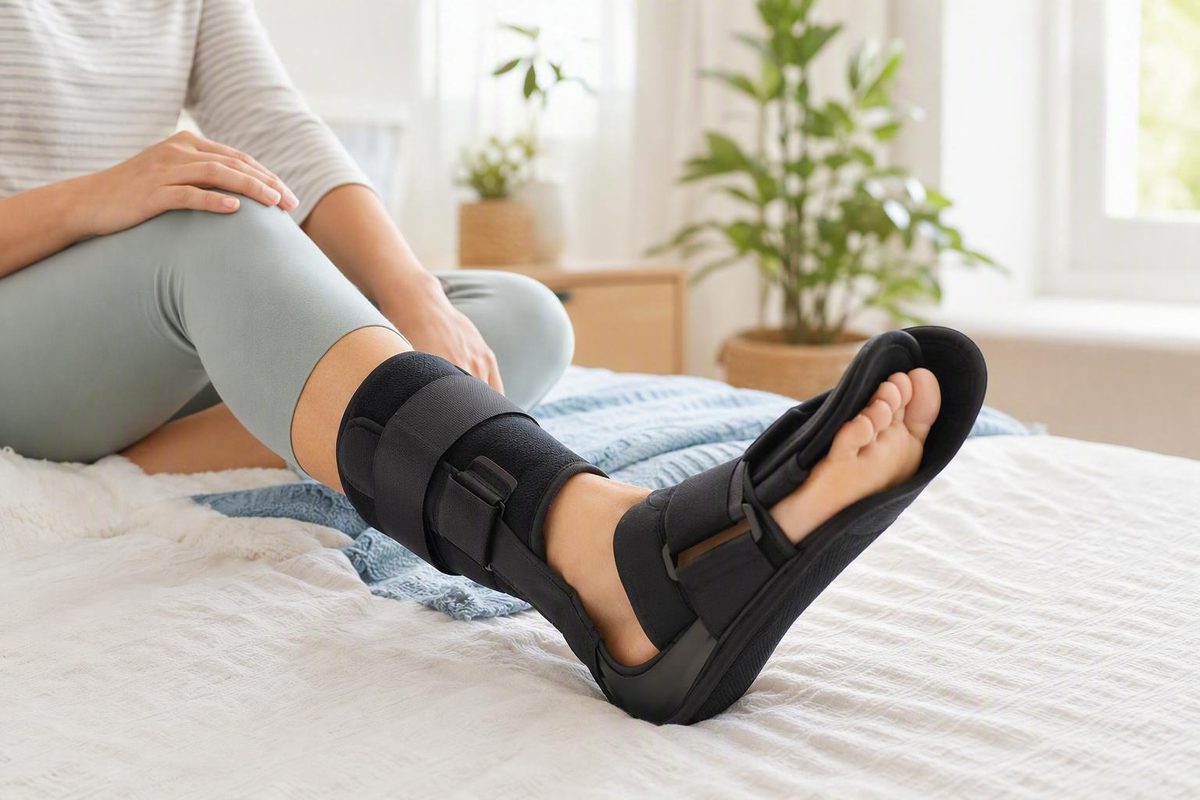
A dorsal night splint may be worth trying when plantar heel pain is consistently worst during the first few steps after waking or after sitting. Buy for secure fit, tolerable adjustment, pressure control, clear instructions, walking restrictions, and return terms rather than promises of a cure.
The short answer: who is a night splint most likely to suit?
Decision box
A night splint most closely aligns with current guidance when:
- pain is around the underside or inner side of the heel;
- it is consistently prominent on the first steps after waking or resting; and
- plantar fasciitis is the likely diagnosis.
Do not assume it is the right tool when:
- pain occurs only during activity;
- the cause is uncertain;
- symptoms are worsening; or
- numbness, marked swelling, skin changes, or a change in walking has appeared.
The typical plantar-fasciitis pattern is pain around the plantar-medial heel—the underside of the heel toward its inner edge. It is commonly most noticeable during initial weight bearing in the morning or after a period of rest. That pattern is the clearest decision filter because the 2023 heel-pain clinical practice guideline recommends a one-to-three-month night-splint program specifically for people who consistently experience first-step morning pain.
That recommendation applies to night splints as a category. It is not a guarantee of improvement, proof of a diagnosis, or evidence that a dorsal brace is superior. Clinical guidelines also leave room for individual findings, treatment options, preferences, and tolerance.
If your pain occurs only during activity, is steadily increasing, changes how you walk, or does not resemble first-step plantar heel pain, an individual assessment is more appropriate than choosing a splint from a product description alone.
What a dorsal night splint does—and what it cannot promise
A dorsal night splint is positioned over the front, or top, of the foot and lower leg. Its shell and straps are designed to hold the ankle near a neutral position while you sleep or rest.
The proposed purpose of a night splint is to keep the plantar fascia and calf structures from resting in a shortened position.
Some models add a toe-assist strap or hallux sling. This lifts the great toe with the intention of engaging the foot’s windlass mechanism and adding tension through the plantar fascia. DARCO documents a Hallux Sling, while Aircast describes an optional toe-assist strap. These are genuine design features, but the reviewed independent evidence does not establish that lifting the great toe improves pain, recovery, comfort, or adherence compared with ankle positioning alone.
It helps to separate three kinds of statement:
- Documented construction: a rigid shell, padded liner, adjustable strap, heel opening, traction surface, or toe sling.
- Intended mechanical action: holding the ankle or great toe in a particular position.
- Therapeutic or commercial claim: reducing inflammation, preventing injury, speeding recovery, improving adherence, or producing superior pain relief.
Construction and adjustment details can usually be checked in product instructions. Claims about clinical outcomes require stronger evidence. A product page describing how a splint is intended to work does not prove that the particular model will relieve your pain.
Dorsal vs. posterior vs. sock-style splints
The main designs approach the same positioning goal differently.
| Design and placement | Profile and support | Typical adjustment | Evidence limitation |
|---|---|---|---|
| Dorsal: shell over the front of the lower leg and foot | Commonly described as lower-profile; stability depends on shell shape and fit | Calf, foot, or flexion straps; some models add toe assistance | A lighter design does not prove better comfort, adherence, or effectiveness |
| Posterior: brace behind the calf and under the foot | Often more substantial and may provide firmer support | Straps usually control ankle position and lower-leg retention | Pressure, heat, bulk, fit, and sleep tolerance vary by person |
| Sock-style: fabric splint linked to a forefoot strap | Uses fabric and strap tension rather than a rigid dorsal or posterior shell | Forefoot tension is commonly adjustable | Evidence does not establish that all current products perform equivalently |
A dorsal shell follows the front of the shin and top of the foot. A posterior splint runs behind the lower leg and continues underneath the foot. Dorsal products are often characterized as lighter or less bulky, while posterior models may provide more substantial support. Neither description proves which design will be more comfortable for a particular person. A dorsal shell can press on the top of the foot, while a well-fitted posterior splint may feel more stable.
An older plantar-fasciitis guideline reported no apparent outcome difference among anterior, posterior, and sock-style splints. Its evidence base relied on literature published before May 2007, so the finding should not be stretched into a claim that every current brace is interchangeable. The newer guideline does not identify a superior design either.
Product comparison: shop by fit and adjustability, not promises
The commercial details below were checked against the cited pages on September 13, 2026. Prices, sizing, availability, warranties, and return terms can change; recheck every field on the live seller page immediately before publication or purchase. Products are not ranked because price, ratings, and marketing claims do not establish clinical superiority.
| Product | Displayed price and sizing | Documented construction or adjustment | Buying caution |
|---|---|---|---|
| DARCO Body Armor | $75; universal sizing; one splint | Fits either foot; Hallux Sling | “Universal” does not guarantee a secure heel or lower-leg fit |
| Aircast Dorsal Night Splint | S/M: men’s 5–9.5, women’s 6–10.5; L/XL: men’s 10–14, women’s 11–15 | Adjustable dorsiflexion strap, padded liner, optional toe-assist strap, non-skid sole; fits either foot | Specifications appear in the brochure’s Dorsal Night Splint section and ordering table; a non-skid sole is not proof of suitability for routine walking |
| PowerStep Dorsal Night Splint | $56.95; regular and large; one splint | Polypropylene dorsal shell, padding, adjustable closures and flexion strap, heel opening, silicone beading | Women’s sizing information is inconsistent within the page |
| BraceAbility Dorsal Night Splint | Sale price $36.99; S/M and L/XL | Latex-free rigid shell, padding, open heel, three adjustable straps | Intended for sleep or rest, not ordinary walking |
| United Ortho Dorsal Night Splint | $26.39; chart shows S/M and L/XL | Non-slip plantar pad; six-month defect warranty | Product selector lists four separate sizes that do not match the two combined chart categories |
| Breg Dorsal Night Splint | Price not displayed; S, M, L, and XL | Fits either foot; low-profile construction; hook closure | The readable page does not expose the actual sizing measurements |
“Bilateral” or “fits either foot” means the same device can be used on the left or right foot. It does not mean that one included splint can treat both feet simultaneously.
For Aircast, the cited manufacturer brochure covers several products, but it contains a separate Dorsal Night Splint feature panel and ordering table. That section documents the two left-or-right size ranges, adjustable dorsiflexion strap, padded liner, optional toe-assist strap, and non-skid sole.
PowerStep lists regular as men’s 5–9 and women’s 6–10, and large as men’s 9–14 and women’s 10–15. Another specification on the same page presents the women’s range differently. If you are near a boundary, ask the seller which chart controls rather than assuming the larger size will solve the problem.
BraceAbility lists S/M for women’s 6–10 and men’s 5–9, and L/XL for women’s 10.5–15 and men’s 9.5–14. It also supplies brace heights, which may help you estimate where the shell and calf strap will land when shoe size alone is not enough.
United Ortho’s chart groups fit into S/M and L/XL, but its selector offers Small, Medium, Large, and Extra Large. Breg lists four sizes but does not expose their measurements in the readable page text. In either case, resolve the uncertainty with the seller before ordering.
Before checkout, compare:
- shoe-size range and what happens at boundary sizes;
- heel width, heel opening, and retention;
- ankle and lower-leg fit;
- calf-strap height and closure range;
- shell edges and padding;
- strap placement over the top of the foot;
- presence and removability of a toe-assist feature;
- materials and latex information;
- cleaning instructions;
- traction features and walking restrictions;
- quantity included;
- warranty; and
- return or exchange terms, including hygiene restrictions.
A generous return policy can matter as much as a feature list. Shoe size cannot tell you whether the heel will stay seated, whether the calf strap will close securely, or whether the shell edge will press on a sensitive area.
A practical fitting and adjustment checklist
Use the instructions for your exact model and size. Similar-looking braces may have different strap sequences, allowable tension, or walking restrictions. The following general sequence reflects practice-published fitting guidance, but manufacturer-specific instructions take priority.
- Read the instructions first. Identify every strap, the intended shell position, cleaning requirements, and any model-specific warnings.
- Loosen the straps. Do not force your foot through tightened closures.
- Place the foot fully into the brace. Keep the shell aligned over the foot and lower leg rather than twisted to one side.
- Seat the heel. The heel should occupy the intended opening or rear position instead of floating forward.
- Secure the foot or toe strap. Use enough tension to stabilize the forefoot without digging into the top or sides of the foot.
- Secure the calf strap. Tighten it enough to limit sliding, but do not keep pulling simply because excess strap remains.
- Adjust the stretch gradually. Aim for tolerable tension rather than forcing the ankle to an advertised angle.
- Check every contact point. Pay particular attention to the top of the foot, heel, ankle bones, calf, straps, and shell edges.
The target is snug, stable, and tolerable—not tight. The supplied evidence does not establish one exact ankle angle, universal break-in schedule, or required number of hours per night. A model described as holding the foot near 90 degrees should not be treated as an instruction to force a painful position.
Shoe size is only a starting point. If you are close to a size boundary, have a particularly lean lower leg, need more calf room, or find that the heel moves despite correct positioning, examine the closure range and return terms instead of relying on a “universal” label.
Customer reviews can reveal possible practical problems, but they cannot show how frequently a problem occurs or establish a product’s safety or effectiveness. On the PowerStep product page, individual reviewers report issues including top-of-foot or heel pressure, poor security around a lean lower leg, and closure wear. Treat these as possibilities to check for, not predicted outcomes.
If the splint slips or hurts
- If the heel lifts, reseat it before changing strap tension.
- If the brace slides, check shell alignment, calf fit, and size.
- If pressure develops, reassess the relevant strap and padding.
- Do not respond by tightening every strap.
- Stop wearing it if repositioning does not remove painful pressure.
Wearing, walking, cleaning, and stop-use warnings
Dorsal night splints are primarily intended for sleep or rest. A non-slip sole, silicone beading, or plantar traction pad does not turn a night splint into ordinary walking footwear. Product wording also varies: one manufacturer may allow a few household steps, while another refers to “limited ambulation” without defining its limits.
For nighttime bathroom trips, follow the instructions for your exact model. Remove the splint when practical rather than assuming its traction surface makes routine walking safe.
Stop using the splint if pain, swelling, numbness, or skin irritation increases, and contact a healthcare professional. Those stop-use signs are included in the practice-published usage guidance. Do not keep increasing tension in an attempt to “push through” worsening symptoms.
Sudden severe pain, spreading redness, or numbness deserves prompt clinical attention, particularly if you have diabetes.
Hand washing with mild soap followed by air drying is common across the sourced product instructions, but your model’s care directions take priority. Do not assume that the shell, liner, or closures are removable, machine washable, or safe near direct heat.
Inspect your skin and the brace regularly. Look for persistent redness, rubbing, damaged padding, worn hook-and-loop closures, cracked parts, or a fit that no longer stays secure. The evidence does not establish a clinically validated inspection timetable; the practical aim is to identify pressure or wear before it becomes worse.
Use it as one part of a broader heel-pain plan
Its best-supported role is within a broader conservative plan for plantar heel pain that is consistently prominent during the first steps in the morning.
Depending on an individual assessment, companion care may include:
- plantar-fascia-specific stretching;
- calf stretching;
- resistance exercise for the foot and ankle;
- manual therapy; and
- taping.
The current clinical practice guideline supports these options as clinically appropriate. It also says foot orthoses may be combined with other care but should not be presented as an isolated treatment for short-term pain relief.
Treat the recommended program length as a treatment window, not a promised deadline. Reassessment is appropriate when:
- the diagnosis remains uncertain;
- symptoms persist or worsen;
- pain changes how you walk;
- the splint cannot be fitted without pressure or slipping; or
- neurological, skin, or circulation concerns appear.
Keep the evidence boundary clear when reading product pages. Sellers may also advertise particular braces for Achilles disorders, heel spurs, foot drop, or contracture, but evidence supporting night splints for plantar fasciitis does not automatically prove effectiveness for those separate conditions.
For the right symptom pattern, a dorsal night splint is a plausible addition to conservative care. Choose it by verified fit, adjustability, pressure control, instructions, walking restrictions, and return terms—and stop if it causes worsening pain, swelling, numbness, or skin irritation.
Does a toe-assist strap or hallux sling make a dorsal night splint more effective?
That has not been established. A toe-assist strap or hallux sling is intended to lift the great toe and engage the windlass mechanism, potentially adding tension through the plantar fascia. It is a meaningful design difference, but the reviewed independent evidence does not show that it improves pain, recovery, comfort, or adherence compared with ankle positioning alone.
Treat it as an optional adjustment feature rather than a proven upgrade. If it creates pressure at the toe, forefoot, or top of the foot, do not assume that adding more tension will produce a better result.
How many hours per night should I wear a dorsal night splint?
Guidelines describe a treatment course lasting one to three months, but they do not establish one mandatory number of hours per night or a universal break-in schedule for all users.
Follow the instructions for your exact model and any individual guidance you have received. Use only tolerable tension, and do not force immediate full-night wear if the splint causes increasing pain, swelling, numbness, skin irritation, or major sleep disruption.