
Foot Wart vs Callus: Skin Lines and Pressure Clues
Skin lines often continue through a callus but may stop around a wart. If clues conflict, avoid acids, freezing, cutting or aggressive filing pending assessment.
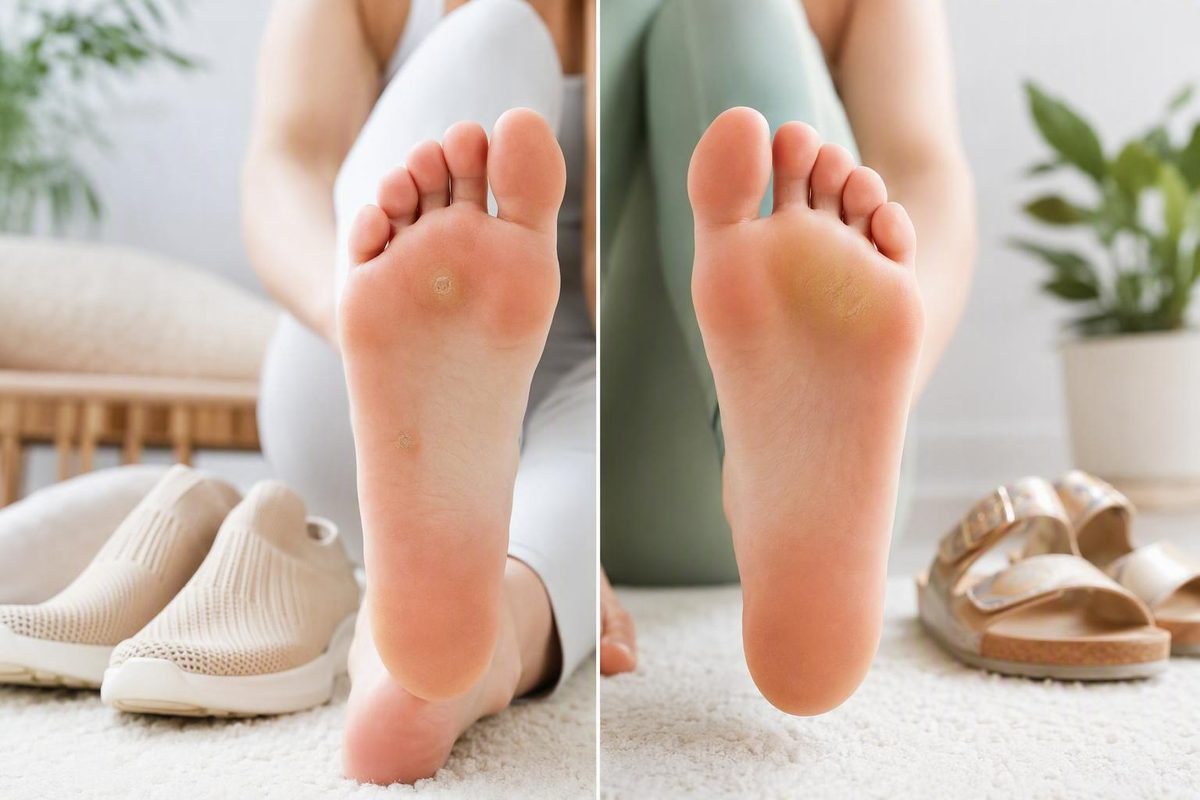
A plantar wart is an HPV-related growth on the sole of the foot. A callus is skin that has thickened in response to repeated pressure, friction or irritation. They can look remarkably similar—especially on a weight-bearing area—but they have different causes and require different responses. Pressure can also push a plantar wart inward and give it a thick, callus-like surface. Harvard Health explains how HPV causes plantar warts and how weight-bearing pressure can flatten them.
Several clues can shift the probability one way or the other: natural skin lines, pinpoint dark dots, overall shape, texture, location, tenderness and whether similar spots are appearing nearby. No single feature confirms the diagnosis. If the clues conflict, avoid acids, freezing, cutting and aggressive filing until a qualified clinician has examined the lesion.
Foot wart vs callus: the differences at a glance
A typical callus is broad, firm and flat or diffuse. It often develops at a predictable pressure point, such as the heel or ball of the foot. A plantar wart is more likely to be a discrete, rough, grainy or irregular growth, although body weight may flatten it or push it inward.
Every feature below is a clue, not a diagnostic test:
| Feature | Callus clues | Plantar wart clues |
|---|---|---|
| Cause | Repeated pressure, friction, rubbing or irritation | HPV entering through a small cut or break in the skin |
| Typical shape | Broad, flat, spread out or diffuse | More discrete or clearly bounded; may be flattened or pushed inward |
| Surface texture | Firm, thickened, dry, waxy or relatively smooth | Rough, grainy, irregular or sometimes cauliflower-like |
| Borders | Often indistinct or diffuse | May have a more distinct edge |
| Natural skin lines | Usually continue across the thickened skin | May stop, bend or be displaced around the lesion |
| Dark dots | Not a typical feature | Pinpoint black or dark-red dots may be visible |
| Tenderness pattern | May hurt more with direct downward pressure | May hurt more when gently squeezed from the sides |
| Common location | Predictable pressure points, including the heel and ball of the foot | Anywhere on the sole, including weight-bearing areas |
| Contagiousness | Not contagious | Can spread through direct or indirect contact |
| First safe action | Reduce rubbing and pressure while monitoring it | Avoid picking and shared tools; confirm the diagnosis before destructive treatment |
Natural ridges commonly continue through a callus but may be interrupted or displaced by wart tissue. The tiny black or dark-red dots sometimes seen in a wart are clotted small blood vessels—not seeds, dirt or roots. Calluses may be more uncomfortable when pressed straight down, while warts may be more sensitive to gentle side-to-side pressure. Either lesion can nevertheless be painful or painless, and none of these signs is conclusive. Treasure Valley Foot & Ankle describes these commonly used comparison clues and emphasizes that they do not replace professional diagnosis.
Do not let one feature decide the issue. A wart may have no visible dots, a callus can hurt, and thick skin can conceal the surface of a wart. Appearance alone may not settle the foot wart vs callus question.
Why a callus and a plantar wart can look alike
Calluses form because the skin repeatedly encounters load or irritation. The outer layer thickens in an attempt to protect the area. That is why a callus often corresponds with a shoe hot spot, recurring activity or part of the foot that consistently carries more pressure.
A plantar wart starts differently. HPV enters through a small cut or break in the skin and produces a growth on the sole. It may still occur in a high-pressure location, and standing or walking can force it inward instead of allowing it to project above the surrounding skin.
The overlap can go further: callused skin may develop over or around a wart. That covering can conceal the wart’s rough surface, vascular dots or interrupted skin lines. A smooth, thick surface therefore does not automatically rule out a wart.
A callus cannot turn into a wart. One is a mechanical response and the other is an HPV-related growth. They can, however, occupy the same area. A wart beneath a pressure point may acquire an overlying callus, or a wart may develop close to an existing callus.
Location is weak evidence by itself. A thick patch directly beneath a recurring pressure point favors a callus, but plantar warts can also occur on the heel, forefoot and other weight-bearing parts of the sole. Both conditions may become uncomfortable while standing or walking. Cleveland Clinic describes calluses as broad, flattened areas caused by repeated friction, rubbing, irritation or pressure and notes that plantar warts can resemble them. Its clinical overview also identifies common callus locations and explains that HPV enters through a break in the skin.
A corn is another possible source of confusion. It is generally a smaller, more concentrated pressure lesion than a broad callus and may have a defined central core. This article focuses on the more common home question of a plantar wart versus diffuse pressure-thickened skin, but a small, focused lesion should not automatically be assigned to either category.
A safe multi-clue check you can do at home
Treat this inspection as a provisional probability check, not a diagnosis. Use good lighting, clean hands and a mirror if needed. Do not cut, scrape or peel the spot to expose what is underneath.
-
Look for a pressure or friction source. Consider whether the same area rubs against a shoe seam, compressed insole or tight sock. Think about recent increases in walking, running, standing or another repetitive activity. An obvious mechanical source supports a callus, but it does not exclude a wart.
-
Inspect the overall shape. A broad, flat or diffuse patch favors a callus. A discrete, irregular or grainy growth favors a wart. Inspect the surface as it is; cutting can injure healthy skin and is unsafe when the lesion’s identity is uncertain.
-
Follow the natural skin ridges. Look at the fine lines that form the footprint pattern. Lines that continue through the thickened area favor a callus. Lines that stop, curve around or appear displaced by the lesion favor a wart. Thick overlying skin may make the pattern difficult to interpret.
-
Look for pinpoint dots. Tiny black or dark-red points support the possibility of a wart because they may represent clotted small vessels. Their presence does not prove the diagnosis, and their absence does not rule out a wart. Do not cut or scrape the lesion to search for them.
-
Compare tenderness gently. First apply light downward pressure. If that is comfortable, apply very gentle pressure from opposite sides. Greater discomfort with direct pressure may favor a callus; greater discomfort with side-to-side squeezing may favor a wart. This commonly cited pinch check is not definitive, particularly with large, deep or heavily callused lesions. Stop immediately if it causes significant pain.
-
Consider whether the spots are multiplying. A lesion that forms a cluster or is followed by similar spots nearby may favor a contagious wart. A callus may recur at several areas exposed to similar pressure, but it does not spread as an infection.
A dermatology practice comparison describes preserved skin lines as a callus clue and interrupted lines or vascular dots as wart clues, while also warning that persistent or atypical lesions may require professional evaluation. Its guidance supports using the signs together rather than relying on one feature.
Here are three bounded examples of how the clues might combine:
- More consistent with a callus: A broad patch beneath the ball of the foot has ridges running through it, and the corresponding shoe insole is compressed at that exact point.
- More consistent with a wart: A discrete, grainy spot interrupts the natural ridges and contains several pinpoint dark dots.
- Genuinely uncertain: A smooth, thick area has a small rough center, suggesting that callused skin could be covering a wart.
In the third situation—and whenever the clues disagree—do not use a destructive treatment merely to find out what lies beneath the surface.
What to do when the clues conflict
An overlapping appearance is not unusual. Pressure may flatten a wart, while callused skin can hide the features that otherwise distinguish it. A photograph or online checklist cannot confirm every ambiguous lesion or establish that the spot is safe to treat at home.
While waiting for assessment, choose non-destructive measures:
- Keep the area clean and dry.
- Protect it from rubbing.
- Reduce pressure with suitable cushioning or a temporary activity adjustment.
- Note any change in size, color, texture or discomfort.
- Do not cut, shave or aggressively file it.
- Do not apply wart acid, chemical callus remover or home freezing treatment simply as an experiment.
Professional evaluation generally begins with visual and clinical examination. A clinician may inspect the lesion’s texture, skin markings and visible dots and assess tenderness. If its appearance remains uncertain or unusual, further evaluation—and sometimes biopsy—may be considered, but biopsy is not routine for every suspected wart or callus. Inspira Health outlines visual and clinical examination and notes that biopsy may sometimes be used when a suspected wart remains uncertain.
Correct identification matters because the goals of care differ. Pressure relief addresses the repeated mechanical force behind a callus. Wart treatment targets infected tissue or attempts to stimulate an immune response. Treating one as the other may irritate healthy skin, fail to address the cause or contaminate a tool used on a suspected wart.
Corns, wounds and other skin conditions can also resemble a wart or callus. Arrange professional evaluation if the lesion remains difficult to identify, repeatedly returns, changes unexpectedly or does not respond as expected to conservative pressure relief.
Safe next steps for a likely uncomplicated callus
If several clues favor a straightforward callus and you have no high-risk medical factors, begin by addressing the source rather than concentrating only on removing thick skin.
Check:
- Shoe length and width
- Toe-box room
- Interior seams or rough edges
- Compressed or uneven insoles
- Sock size, bunching and seam placement
- Cushioning beneath the affected area
- Whether a recurring activity loads or rubs the same spot
Properly fitted footwear, cushioning and pressure-relieving pads may reduce the load. A short adjustment to an aggravating activity may also help. These measures support pressure management; they do not guarantee that every thick lesion will resolve or replace assessment when the diagnosis is uncertain.
Moisturizer is a conservative way to soften dry, thickened skin. Urea- or lactic-acid moisturizers are sometimes suggested for calluses, but the appropriate product depends on the condition of the skin and individual risk factors. Do not apply an active product to cracked, bleeding or unidentified tissue without professional advice.
Gentle use of a pumice stone or foot file may be reasonable only when all of the following apply:
- The lesion is reasonably believed to be an uncomplicated callus.
- The skin is intact and not inflamed or infected.
- You do not have diabetes, neuropathy, poor circulation, reduced sensation, fragile skin or impaired healing.
- You can stop well before the area becomes sore, raw or starts bleeding.
Never cut or shave a callus with a blade. Chemical callus removers can injure surrounding healthy skin if applied imprecisely. Cleveland Clinic advises against sharp-object removal and says people with diabetes, poor circulation, delicate skin or increased infection risk should not self-treat. Its callus guidance centers care on pressure reduction, footwear changes, padding and cautious skin care.
Removing surface thickness without correcting the pressure source may provide only temporary improvement. If the same callus keeps returning, footwear, activity, gait or foot structure may be continuing to concentrate force there.
Arrange an assessment for a callus that is painful, cracked, recurrent, inflamed, infected, difficult to identify or limiting standing and walking.
Safe next steps for a suspected plantar wart
A suspected plantar wart calls for containment rather than routine callus filing. HPV can spread to nearby skin or other people through direct contact or indirectly through contaminated surfaces and personal items.
Practical precautions include:
- Do not pick, cut or peel the lesion.
- Avoid aggressive filing, which can injure tissue and contaminate the tool.
- Do not share pumice stones, files, towels, socks or other items that touch it.
- Never reuse a wart-contact tool on unaffected skin.
- Cover the area when practical, particularly if it may touch shared surfaces.
- Keep feet dry and change damp socks.
- Wear sandals or other footwear in communal showers, locker rooms and pool areas.
Some plantar warts clear without treatment, but they may persist for a prolonged period, particularly in adults. Treatment may be appropriate when a confirmed wart is painful, spreading or otherwise troublesome.
Salicylic acid is a commonly used treatment for a confirmed wart in an otherwise appropriate low-risk person. It should not be used as a diagnostic experiment: acid can injure healthy tissue, particularly when the lesion is not a wart or when sensation and healing are impaired.
Clinician-directed options may include cryotherapy, prescription topical treatment, cantharidin, immunotherapy, laser treatment or, occasionally, surgery. The appropriate choice depends on the lesion, its location, previous treatment, discomfort tolerance and the person’s health. No single approach works every time.
Set realistic expectations. Wart treatment may take weeks or months, require repeated applications or clinical visits, cause discomfort and still be followed by recurrence. Evidence for duct tape is mixed. Apple cider vinegar is not recommended here because the available material does not establish it as a reliably safe or effective treatment. Harvard Health reviews watchful waiting, salicylic acid and clinician-directed options while noting that plantar warts can persist and treatment may require repetition.
When not to self-treat—and when to seek prompt care
Do not self-treat an unidentified foot lesion if you have diabetes, peripheral neuropathy, poor circulation, reduced foot sensation, fragile skin, impaired healing or weakened immunity. Obtain professional advice before using acid, freezing, cutting or abrasion.
Reduced sensation can allow a chemical, freezing or abrasion injury to develop without being noticed. Thick callused skin may also conceal a wound. A clinic-authored article from Tanglewood Foot Specialists specifically warns that diabetes and peripheral neuropathy require additional caution because acids may damage tissue without being felt and callused skin may hide a wound. Its guidance advises assessment rather than filing or chemically treating an uncertain lesion.
Arrange a clinical evaluation when the spot is:
- Difficult to identify
- Becoming more painful
- Multiplying or spreading
- Repeatedly returning
- Failing to improve as expected
- Interfering with standing or walking
These findings do not prove that the original spot is a wart or callus; they may indicate tissue injury, infection or another condition that should not be repeatedly treated at home. Treasure Valley Foot & Ankle identifies rapidly increasing redness or warmth, drainage and red streaks as reasons for prompt care. Its safety guidance also advises professional assessment when the diagnosis is uncertain.
Sudden severe pain, spreading redness or numbness deserves clinical attention, particularly if you have diabetes, as stated in The Shoes for Me’s general foot-health safety notice.
This article provides general information, not medical diagnosis or treatment.
Preventing recurrence and spread
Because calluses and plantar warts have different causes, they need separate prevention strategies.
To reduce callus recurrence:
- Wear shoes with adequate length, width and toe-box space.
- Use suitable cushioning and socks that do not bunch or create pressure seams.
- Consider protective padding where repeated friction occurs.
- Modify activities that repeatedly load the same point.
- Inspect shoe interiors for narrow areas, damaged seams and compressed cushioning.
- Compare the outsole or insole wear pattern with the location of the callus.
- Replace footwear or cushioning that no longer distributes pressure adequately.
If the same callus returns after repeated surface removal, the persistent pressure source deserves attention. Assessment may include footwear, activity, gait and foot structure rather than simply removing thick skin again. A podiatry comparison guide emphasizes pressure reduction, shoe and sock fit, cushioning and skin care as central to limiting callus recurrence. Its recommendations keep footwear in a pressure-management role rather than treating it as a universal cure.
To reduce the spread of a suspected wart:
- Wear footwear in communal wet areas.
- Keep feet clean and dry.
- Avoid picking or scratching the lesion.
- Cover it when practical.
- Do not share towels, socks, footwear or foot-care tools.
- Reserve any tool that has touched the suspected wart for that lesion alone.
- Never use a wart-contact file or pumice stone on healthy skin.
- Wash your hands after touching or covering the area.
Footwear and pressure relief may make walking more comfortable over either lesion, but they do not treat the HPV infection responsible for a wart.
The practical decision is straightforward: use pressure relief for a likely callus, containment precautions for a suspected wart, and professional assessment whenever either the identity of the lesion or the safety of treatment remains uncertain.
Frequently asked questions
Can a callus turn into a plantar wart?
No. A callus is a mechanical thickening of skin caused by recurring pressure or friction; a plantar wart is an HPV-related growth. A callus cannot transform into an infection.
The two can occur together, however. Pressure can create callused skin over or around an existing wart, concealing its rough surface, dots or disrupted skin lines. That overlap may make it appear that a callus has changed into a wart when both processes are present in the same area. A podiatry comparison guide explains that a callus cannot turn into a wart, although a wart may develop near or beneath callused skin.
Do black dots always mean a foot lesion is a wart?
No. Pinpoint black or dark-red dots favor a wart because warts can contain clotted small blood vessels. They are not seeds or roots.
Visible dots do not prove that a lesion is a wart, and a wart may have no obvious dots—especially when thick callused skin covers it. Interpret dots alongside the skin-line pattern, surface texture, shape, history and tenderness. Do not cut or scrape the lesion to search for them.
Is the side-to-side pinch test a reliable way to diagnose a plantar wart?
No. It is a clue, not a reliable stand-alone diagnostic test. Greater tenderness when the lesion is gently squeezed from the sides may favor a wart, while greater discomfort under direct downward pressure may favor a callus. Either lesion can still be painful, painless or ambiguous.
Use only light pressure and stop if it causes significant discomfort. Consider the result alongside skin lines, dots, texture, shape and spread—not as a diagnosis by itself.
Can I use a pumice stone if I am not sure whether the spot is a wart or a callus?
No. Wait until the lesion’s identity and the safety of treating it are reasonably clear. A pumice stone may be appropriate for cautious thinning of a confirmed, uncomplicated callus in someone without high-risk medical factors, but abrading a suspected wart may injure tissue and contaminate the stone.
If a tool has touched a suspected wart, do not share it or use it on healthy skin. When uncertain, use non-destructive protection and pressure relief while arranging an assessment.
Are plantar warts contagious while calluses are not?
Yes. Plantar warts are caused by HPV and can spread through direct contact, to nearby skin or through contaminated objects and surfaces. Calluses are produced by pressure or friction and are not contagious. A podiatry comparison describes this distinction while noting that both conditions may occur on weight-bearing areas and look similar.
Remember the three-part rule: preserved skin lines plus an obvious pressure source favor a callus; interrupted lines, a grainy surface or pinpoint dark vessels favor a plantar wart; conflicting clues mean no acids, freezing, cutting or aggressive filing until the lesion is assessed. Use footwear and pressure relief for a likely callus, hygiene and separate tools to limit suspected wart spread, and seek clinical advice directly if you have high-risk health conditions or warning signs.