
Which Walking Boot Is Right for a Broken Metatarsal?
A boot can protect a healing foot, but it cannot make every metatarsal fracture safe to walk on or replace appropriate assessment and follow-up.
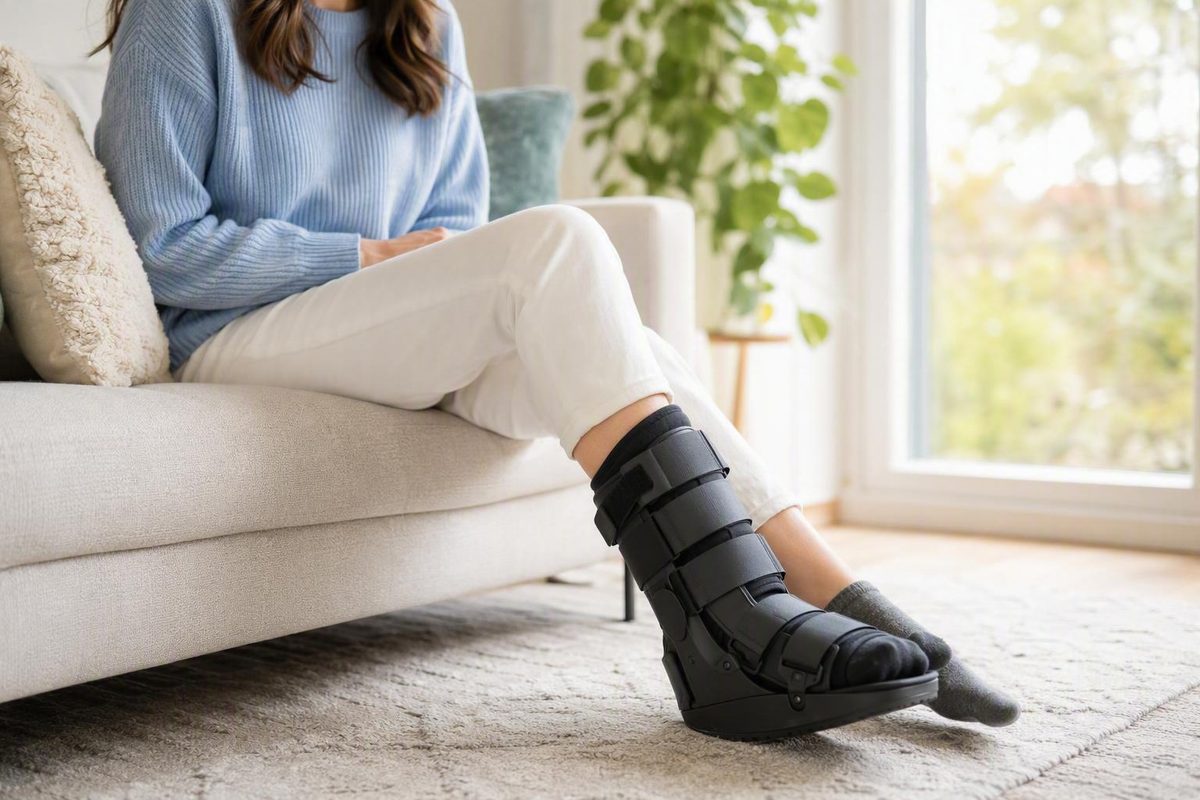
A walking boot is commonly used for some metatarsal fractures, but “broken metatarsal” does not describe one uniform injury. Depending on the diagnosis, the prescribed support might instead be a post-op shoe, hard-soled shoe, cast, or an individualized device used after specialist treatment.
The choice depends on the fracture’s exact location, pattern, stability, displacement, severity, and cause. Those details also determine whether you may put weight through the foot, whether you need crutches, when the support may be removed, and how you transition back to ordinary shoes.
This guide can help you interpret a prescription and compare support options. It cannot determine which treatment is safe for an undiagnosed injury or override instructions from your fracture team.
Start With the Fracture Diagnosis, Not the Boot
If you suspect a metatarsal fracture, seek assessment as soon as possible rather than buying a boot and testing whether walking feels tolerable. Obtain the precise imaging diagnosis and explicit weight-bearing instructions before buying, replacing, or changing support.
It may be aligned or displaced, stable or unstable, isolated or accompanied by other injuries. A fracture through weakened bone presents a different clinical problem again.
For practical purposes, the available guidance falls into three bounded groups:
-
Metatarsal stress fractures. These develop through repetitive loading rather than one acute impact. One podiatry clinic recommends a regular tall medical boot for its metatarsal stress-fracture patients, while emphasizing prompt assessment and clinician- and imaging-guided discontinuation. This is a clinic practice recommendation, not proof that every stress fracture requires a tall boot or that the same approach applies to an acute break. See the clinic’s metatarsal stress-fracture guidance.
-
Selected fifth-metatarsal base avulsion fractures. Some diagnosis-specific pathways permit weight bearing as tolerated in a boot, post-op shoe, hard-soled shoe, or cast. These are narrow protocols for particular fractures near the base of the fifth metatarsal—the bone along the outside of the foot.
-
Other acute or complicated fractures. The supplied evidence does not establish a safe self-directed retail-boot protocol for Jones fractures, displaced or unstable fractures, open fractures, multiple fractures, pathological fractures, or surgically treated injuries. These diagnoses fall outside a generic shopping guide and require an individualized treatment plan.
Do not transfer instructions between these groups. Stress-fracture advice cannot automatically be applied to an acute traumatic fracture. Similarly, findings for a selected fifth-metatarsal base avulsion fracture cannot be generalized to a Jones fracture, a metatarsal shaft fracture, or a fracture of another metatarsal.
Ask the treating clinician to write down:
- The exact metatarsal and fracture location
- The fracture pattern and whether it is stable or displaced
- Whether you are non-weight-bearing, partial-weight-bearing, or weight-bearing as tolerated
- Whether and for how long you need crutches or another mobility aid
- The required support type, height, and rigidity
- When the boot or shoe may be removed
- Whether any movement or exercise is permitted
- When follow-up or repeat imaging is due
- What must happen before returning to ordinary footwear, work, driving, exercise, or sport
If the clinician says “wear a boot,” ask whether that means a short or tall boot, a standard or pneumatic model, and whether a rigid full shell is required. Those details are more useful than a product listing that merely says “for metatarsal fractures.”
What a Walking Boot Can—and Cannot—Do
A medical walking boot may also be called a fracture boot, medical boot, walking cast, cast boot, air cast, walker, or CAM boot. CAM means controlled ankle motion. Some CAM boots simply restrict movement; others have settings that control the permitted range of ankle motion.
Mechanically, a boot can:
- Protect the injured area from bumps and some accidental movement
- Restrict bending and rotation through the foot and ankle
- Hold the foot more consistently than an ordinary shoe
- Accommodate some swelling or dressings, depending on its design
- Make clinician-permitted daily mobility more manageable
A boot is only one part of a treatment plan. It does not replace diagnosis, follow-up, prescribed loading restrictions, repeat imaging when indicated, or rehabilitation.
Most importantly, a walking boot does not automatically unload the metatarsals. When you stand or walk, body weight can still pass through the injured foot. The boot may modify motion or redistribute some forces, but wearing one does not grant permission to bear weight.
Mechanical protection must also be distinguished from biological healing. A rigid shell, rocker sole, reinforced upright, or adjustable air bladder may affect fit, motion, stability, or walking mechanics. The supplied evidence does not demonstrate that any of these features makes a metatarsal fracture unite faster.
You may feel substantially better before the fracture is ready for unrestricted walking, running, lifting, or sport.
The boot’s purpose also differs by pathway. One rehabilitation plan describes the boot as a comfort and symptom-relief aid for the particular foot fracture it covers, whereas other protocols use a boot to protect a fracture during permitted activity. These diagnosis-specific approaches should not be blended into a universal rule.
Walking Boot, Hard-Soled Shoe, Post-Op Shoe, or Cast?
The best comparison begins with the job the support needs to do, not with which option appears most convenient.
| Support | Main purpose | Potential advantage | Important limitation |
|---|---|---|---|
| Walking boot | Removable protection with restriction of foot and ankle movement | Adjustable and may accommodate swelling, depending on design | Does not itself determine whether loading is allowed |
| Hard-soled shoe | Restricts forefoot bending with less leg coverage | Lighter and less restrictive than a boot or cast | Provides less control above the foot |
| Post-op shoe | Provides a stiff platform and space for swelling or dressings | Simple construction and easier access to visible areas, depending on design | Fit and coverage vary substantially by model |
| Cast | Provides rigid, non-removable immobilization | Prevents routine removal and maintains consistent restriction | Heavier and not routinely adjustable by the wearer |
| Individually prescribed postoperative support | Protects the foot according to a specialist treatment plan | Can be matched to the procedure and fracture | A retail device must not be substituted for the prescribed plan |
One orthopedic clinic’s base-of-fifth-metatarsal protocol permits either a walking boot or post-op shoe until four weeks after injury, with full weight bearing as tolerated in that support. This shows that a boot is not always the only option within that particular pathway; it does not establish the best treatment for every fifth-metatarsal fracture. Review the clinic’s base-of-fifth-metatarsal protocol.
There is also narrow randomized evidence for a hard-soled shoe, but it must be interpreted precisely. A secondary summary of a multicenter trial reports that 78 adults with selected zone 1 fifth-metatarsal base avulsion fractures were assigned to a hard-soled shoe or short-leg cast, with weight bearing as tolerated in both groups. At six months, mean pain scores on a 100-mm scale were 8.6 mm with the shoe and 9.8 mm with the cast, meeting the trial’s non-inferiority criterion. Mean return to pre-injury activity was 37.2 days with the shoe versus 43.0 days with the cast. Read the trial summary and eligibility caveats.
That trial compared a hard-soled shoe with a short-leg cast. It did not test a walking boot. It also excluded several higher-risk groups, including people with diabetes and those with open or pathological fractures. It therefore cannot prove that boots are superior, equivalent, or unnecessary for other fractures.
Another randomized trial enrolled 72 adults with closed pseudo-Jones avulsion fractures and compared a foot cast with a below-knee short-leg cast. The foot-cast group had better early pain and function results at two and four weeks, but the differences were no longer statistically significant at six or eight weeks. Both casts were used for four weeks, and weight bearing as tolerated was encouraged. This trial also tested plaster casts—not walking boots—and should not be generalized beyond the studied fracture group. Read the peer-reviewed pseudo-Jones casting trial.
A practical decision framework is to identify what the clinician is prescribing:
- Removable protection and broader motion restriction: a walking boot may fit that objective.
- A stiff sole with less leg coverage: a hard-soled or post-op shoe may be sufficient for a specifically selected fracture.
- Rigid, non-removable immobilization: a cast serves a different purpose from a removable boot.
- Reduced or no weight bearing: the support must be paired with the prescribed mobility aid and loading instructions.
- Specialist or postoperative management: use the exact support and rehabilitation plan provided; do not substitute a retail device.
Short vs Tall, Standard vs Pneumatic: Comparing Boot Designs
There is no evidence-based “best walking boot for a broken metatarsal” independent of the diagnosis. Compare designs only after confirming how much of the foot and ankle must be controlled.
| Design | Coverage and motion | Why it might be considered | Main tradeoff |
|---|---|---|---|
| Short boot | Supports the foot and lower ankle while preserving more ankle mobility | When the prescription does not require broader lower-leg restriction | Less control of ankle and lower-leg movement |
| Tall boot | Extends farther up the lower leg and restricts more ankle and foot movement | When broader motion restriction is prescribed | Bulkier, heavier, and creates a larger height difference |
| Soft or partial shell | Uses a flexible or incomplete structural shell | Lighter support where that level of restriction is prescribed | Less structural control |
| Rigid full shell | Provides a more complete, firm enclosure | Greater external restriction | Fit and pressure distribution require careful checking |
| Standard CAM boot | Uses straps and a rigid or semi-rigid shell without inflatable chambers | Straightforward adjustable immobilization | Fit changes depend mainly on liner and strap adjustment |
| Pneumatic CAM boot | Contains adjustable air bladders | Allows compression and liner contact to be fine-tuned | More adjustment complexity, without evidence of faster fracture healing |
Retailer-authored guidance describes short boots as preserving more ankle mobility and tall boots as restricting more of the foot and ankle. It also suggests that some distal metatarsal injuries may be considered for shorter designs, but this is not diagnosis-specific comparative evidence and should not be used as a self-selection rule. See the retailer’s design and coverage comparison.
For metatarsal stress fractures, one podiatry clinic recommends a regular tall boot and does not present a pneumatic model as necessary. That remains an attributed clinical preference, not comparative proof that a tall boot is best for every stress fracture or acute break.
This may help fine-tune fit, but “air” should not be interpreted as “heals faster.” Commercial device information confirms that standard and air-cushioned CAM boots are distinct product categories, but it does not establish better metatarsal-fracture outcomes with pneumatic models. See the manufacturer’s description of CAM and air-cushioned boots.
Useful features to evaluate include:
- Secure straps that remain fastened during prescribed use
- The prescribed shell height and rigidity
- A stable rocker sole that supports the intended rolling step
- Non-skid outsole traction
- A removable, cleanable liner
- Enough room for expected swelling, bandages, or dressings
- A footbed wide enough to avoid edge pressure
- Clear sizing and fitting instructions
- Availability of replacement parts, where relevant
- A return policy that permits exchange after a careful indoor fit check
A rocker sole is a walking feature, not evidence of faster bone healing. Likewise, a product marketed for “metatarsal fracture” or “stress fracture” is not automatically appropriate for your diagnosis. Commercial categories often group together injuries that require different treatment.
Avoid choosing by brand popularity or unsupported recovery promises. Available commercial pages describe products and features, but they do not establish that one named boot is clinically superior.
How a Metatarsal Walking Boot Should Fit
The correct boot should feel secure enough to control unwanted movement but not so tight that it causes pressure, numbness, or circulation changes.
Before buying
Use this checklist:
- Confirm the prescribed boot height and shell rigidity.
- Measure your foot and lower leg exactly as the manufacturer directs.
- Use the sizing chart for that specific model.
- Check whether the boot is universal or made for the left or right foot.
- Confirm that the listing is for a complete boot rather than only a replacement liner.
- Check that the footbed can accommodate expected swelling or dressings.
- Review final-sale, hygiene, return, and exchange restrictions before opening or wearing it.
- Ask whether fitting must be performed by the clinic or medical-equipment supplier.
Do not assume that “medium” means the same thing across manufacturers. Foot length may place you in one size while calf circumference, swelling, or a bulky dressing makes that model unsuitable.
Fitting sequence
Follow the device instructions and any fitting method demonstrated by your clinician. In general:
- Sit down and open the shell and liner fully.
- Place the foot into the liner without twisting the injured area.
- Seat the heel fully at the back.
- Smooth the liner so there are no folds beneath or beside the foot.
- Position the shell components as directed.
- Fasten the straps in the manufacturer’s specified order.
- Tighten them enough to secure the foot without creating focal pressure.
- Stand or walk only if your weight-bearing instructions permit it.
Expected swelling and dressings require sufficient space, but excessive looseness can allow the heel to lift or the foot to slide and rotate. Manufacturer measurements, the model-specific sizing chart, adjustable fasteners, and a snug but comfortable fit are central considerations. Review the fitting and sizing guidance.
Signs that the boot needs prompt reassessment include:
- Heel lifting or the foot sliding substantially
- Pressure concentrated along a shell edge
- Persistent rubbing or a developing blister
- Numbness or tingling
- Toes becoming pale, blue, unusually cold, or markedly swollen
- New or increasing pain after the straps are tightened
- A liner folded or creased beneath the foot
Swelling can change during the day, so recheck the fit and visible skin rather than relying on how the boot felt in the morning. Do not independently change prescribed CAM motion settings. If the boot is pneumatic, adjust air pressure only according to professional and manufacturer instructions.
Check that the boot does not rock unpredictably when you stand and that the outsole is suitable for the surfaces you must cross. Neither feature proves that the fracture is adequately protected.
A tall sole can leave the injured leg effectively longer than the other leg. A supportive shoe with a similar sole height, or an appropriate shoe balancer on the uninjured side, may reduce asymmetry. It should not make the other shoe loose, unstable, or difficult to clear from the floor.
Comfort alone may not reliably reveal damaging pressure, skin injury, or circulation problems.
Weight Bearing, Crutches, Sleep, Washing, and Daily Care
A walking boot does not give you permission to bear weight. Follow the exact instruction provided by the treating clinician:
- Non-weight-bearing: no body weight through the injured foot.
- Partial weight-bearing: only the amount or proportion specified by the clinician.
- Weight-bearing as tolerated: loading is permitted only within the diagnosis-specific plan and your symptom tolerance.
- Full weight-bearing: full loading is allowed under the prescribed conditions, usually while wearing the specified support.
Selected fifth-metatarsal base avulsion-fracture studies and protocols have permitted full or tolerated weight bearing in a hard-soled shoe, cast, boot, or post-op shoe. Those permissions belong to the studied fracture and treatment plan; they cannot be transferred to a Jones fracture, stress fracture, shaft fracture, another metatarsal, or a postoperative injury. In the hard-soled-shoe trial, weight bearing as tolerated applied to both randomized groups. Review the diagnosis-specific trial summary.
Crutches may still be prescribed when some loading is allowed. Do not stop using them simply because the device is called a “walking” boot.
When can the boot come off?
Removal is prescription-specific. Depending on the injury plan, removal may be allowed:
- While safely seated or lying down
- At night
- For washing
- For a skin check
- For specifically prescribed movement or stretching
Other patients should remove or adjust the boot only when authorized. One injury-specific rehabilitation pathway allows removal at night, while resting, and for washing, but it explicitly applies only to the fracture covered by that plan. See the injury-specific boot-removal pathway.
Ask separate questions about sleep, bathing, exercise, and rest. Permission for one does not imply permission for all. If removal is allowed for washing, sit in a safe place and protect the injured foot from slips, twisting, and accidental loading. Keep the boot, liner, dressings, wound, and surgical site dry as directed.
Daily boot-care routine
- Inspect visible skin, liner edges, and pressure-prone areas every day.
- Check for persistent redness, rubbing, blisters, drainage, or sores.
- Keep the shell and liner dry.
- Make sure straps and shell components remain intact.
- Recheck fit as swelling changes.
- Elevate the injured leg as directed.
- Use cold therapy only according to clinical instructions.
- Use crutches or another mobility aid exactly as prescribed.
- Contact the fracture team if walking becomes more painful or the boot cannot be worn safely.
If you received no individualized cold-therapy instructions, general medically reviewed boot-care guidance gives an example of using a cold pack for 10–20 minutes with a cloth between the pack and skin. This is not appropriate for everyone; surgery, wounds, reduced sensation, circulation problems, and other medical factors require individualized instructions. See Kaiser Permanente’s walking-boot care guidance.
Use handrails and prescribed mobility aids on stairs. Do not improvise exercises, work tasks, or sports because the boot seems protective. Ask the treating clinician specifically about bathing and driving.
If pain increases with walking, you cannot follow the assigned loading limit, or the boot creates unsafe pressure or instability, contact the fracture team rather than changing device settings yourself.
How Long to Wear the Boot and How to Transition Out
There is no universal number of weeks for wearing a walking boot after a broken metatarsal. Online estimates differ because they refer to different fracture locations, causes, severities, clinical populations, and treatment goals.
| Source or pathway | Reported period | What it applies to |
|---|---|---|
| Podiatry clinic practice | 2–4 weeks for many patients | Metatarsal stress-fracture patients treated by that clinic; discontinuation is clinician- and imaging-guided |
| Base-of-fifth clinic protocol | Boot or post-op shoe until four weeks after injury | Base-of-fifth-metatarsal fractures covered by that clinic protocol |
| Commercial stress-fracture guidance | 4–8 weeks | Broad retailer guidance, not a fracture-specific clinical rule |
| General boot-care guidance | 1–6 weeks | General lower-limb boot use, not metatarsal-specific |
| Generic foot-fracture pathway | Boot for comfort during weeks 0–3, then reduced during weeks 3–6 | The particular foot injury covered by that rehabilitation plan |
These figures are not competing answers to the same question. The 2–4-week estimate comes from one clinic’s experience with metatarsal stress fractures. The broad 1–6-week range comes from general walking-boot care. A retailer’s 4–8-week estimate should not override a diagnosis-specific prescription.
The generic foot-fracture pathway uses a boot for comfort during weeks 0–3 and suggests trying to stop using the boot and crutches during weeks 3–6, beginning indoors. That schedule is explicitly injury-specific and is not a template for all metatarsal fractures.
The base-of-fifth-metatarsal clinic protocol takes a different approach: it keeps patients in a walking boot or post-op shoe until four weeks, obtains new X-rays at follow-up, and then gradually transitions them to stiff-soled supportive shoes for another two weeks before other footwear. Again, this is one clinic protocol, not a universal timetable.
Keep four milestones separate:
- Symptoms improving: pain and swelling are settling.
- Fracture healing: the bone is progressing biologically.
- Clinical or imaging evidence: examination and, where indicated, imaging support progression.
- Functional readiness: the foot can tolerate the demands of ordinary walking, work, running, or sport.
Feeling better may occur before the bone is ready for unrestricted loading. Conversely, some residual discomfort may remain even when a clinician considers it appropriate to progress.
A clinician-supervised transition may involve:
- Reducing reliance on the boot according to a schedule
- Beginning with short distances in a controlled indoor setting
- Wearing a stiff-soled supportive shoe if prescribed
- Continuing crutches temporarily if directed
- Increasing walking gradually
- Monitoring pain, swelling, skin condition, and gait
- Returning to the boot or contacting the clinic if the transition fails, according to the plan
Do not assume that walking comfortably for a few minutes means you are ready for running, sport, heavy work, ladders, prolonged standing, or unrestricted footwear. Those activities impose different demands and require separate clearance.
Seek review if significant pain or swelling persists, symptoms worsen, new symptoms appear, or you cannot leave the boot on the expected schedule. Some protocols include diagnosis-specific range-of-motion or stretching work, but perform only the exercises assigned for your injury.
Red Flags and Situations That Need Extra Caution
Get prompt medical help for:
- Severe or worsening pain
- Toes that become pale, blue, unusually cold, or otherwise change color or temperature
- Persistent numbness or new loss of sensation
- Marked or rapidly increasing swelling
- A boot that suddenly feels dangerously tight
- Increasing redness, sores, blisters, drainage, foul odor, or fever
- Moisture affecting a wound or surgical site
- Pain, redness, or swelling in the calf, knee, thigh, or groin
These warning signs are included in medically reviewed walking-boot care guidance and require prompt assessment rather than unsupervised adjustment of the device. Review the warning signs and care instructions.
Calf, knee, thigh, or groin pain accompanied by redness or swelling may indicate a blood clot and warrants urgent medical assessment. Do not assume that loosening the boot solves symptoms extending above or away from the original injury.
Arrange fracture-team review—urgently if symptoms are severe—if:
- Significant pain or swelling continues beyond the expected stage
- You cannot wean from the boot on schedule
- Pain increases whenever you follow the assigned walking plan
- Symptoms develop away from the original injury area
- The boot repeatedly causes rubbing or pressure
- The boot no longer fits because swelling has increased or decreased
- You cannot safely comply with weight-bearing restrictions
Diabetes, neuropathy, peripheral artery disease, wounds, and impaired sensation require extra caution. You may not feel damaging friction or pressure normally, and skin or circulation problems can become serious before the boot feels uncomfortable.
Neither symptom improvement nor an online product description should override imaging findings or clinical restrictions. A seller’s “metatarsal fracture” label cannot establish whether the product controls the movement relevant to your fracture.
When contacting a clinician, be ready to report:
- Your exact fracture diagnosis
- The injury date
- Your current weight-bearing status
- The boot model and size
- When the new symptoms began
- Any toe color, temperature, or sensation changes
- Any redness, blistering, drainage, or wound moisture
- Where swelling or pain occurs
- Whether symptoms improve when the leg is elevated
Frequently Asked Questions
Is a tall or short walking boot better for a broken metatarsal?
Neither is universally better. A short boot supports the foot while preserving more ankle movement. A tall boot covers more of the lower leg and restricts more ankle and foot motion.
The supplied evidence does not establish fracture-location criteria that allow a reader to choose boot height safely without a prescription. One clinic favors a regular tall boot for the metatarsal stress fractures it treats, but that does not prove tall boots are best for all stress fractures or acute breaks.
Use the height and rigidity prescribed for the exact fracture. If the prescription says only “walking boot,” ask the clinician to clarify before purchasing.
Can I put weight on a broken metatarsal while wearing a boot?
Only if the treating clinician has explicitly permitted it. A boot does not eliminate loading through the metatarsals.
Some selected fifth-metatarsal base avulsion-fracture pathways allow weight bearing as tolerated in a boot, post-op shoe, hard-soled shoe, or cast. Other diagnoses may have different restrictions. Crutches may still be needed even when some loading is permitted.
If walking causes increasing pain, you cannot maintain the prescribed loading limit, or you feel unsafe, stop and contact the fracture team.
Can I sleep or shower without the walking boot?
Sometimes, but only when your instructions permit it. Certain injury-specific pathways allow removal at night, while resting, for washing, or for prescribed movement. Other patients should remove or adjust the boot only when authorized.
Ask separately about sleep and bathing. If removal for washing is allowed, sit safely, avoid twisting or loading the foot, and keep the liner, dressing, wound, or surgical site dry as directed. Permission to remove the boot for a skin check does not necessarily mean it may remain off overnight.
Is a pneumatic walking boot better than a standard CAM boot?
A pneumatic boot has adjustable air bladders that can change compression and fit.
The supplied evidence does not show that a pneumatic boot heals metatarsal fractures faster or produces better fracture outcomes than a standard CAM boot. Pneumatic adjustment may be useful when that type of device is prescribed, but more features do not necessarily mean better treatment. Do not overinflate the boot or alter settings without instruction.
Could a hard-soled shoe be enough for a fifth-metatarsal fracture?
Possibly, but only for a carefully diagnosed and selected fracture. In the randomized evidence summarized earlier, adults with selected zone 1 fifth-metatarsal base avulsion fractures had six-month pain outcomes with a hard-soled shoe that were non-inferior to those with a short-leg cast. The shoe group also returned to pre-injury activity sooner on average.
That study did not test walking boots and does not apply automatically to Jones fractures, stress fractures, shaft fractures, open or pathological fractures, or fractures of other metatarsals. Ask whether your imaging shows the specific fracture pattern for which a hard-soled or post-op shoe is appropriate.
The safest action plan is diagnosis-first: confirm the exact fracture and weight-bearing status, use the prescribed level of support, prioritize fit and skin safety over brand claims, and agree on removal, follow-up, and transition instructions with the treating clinician. A boot can protect a healing foot, but it cannot make every metatarsal fracture safe to walk on or replace appropriate assessment and follow-up.